
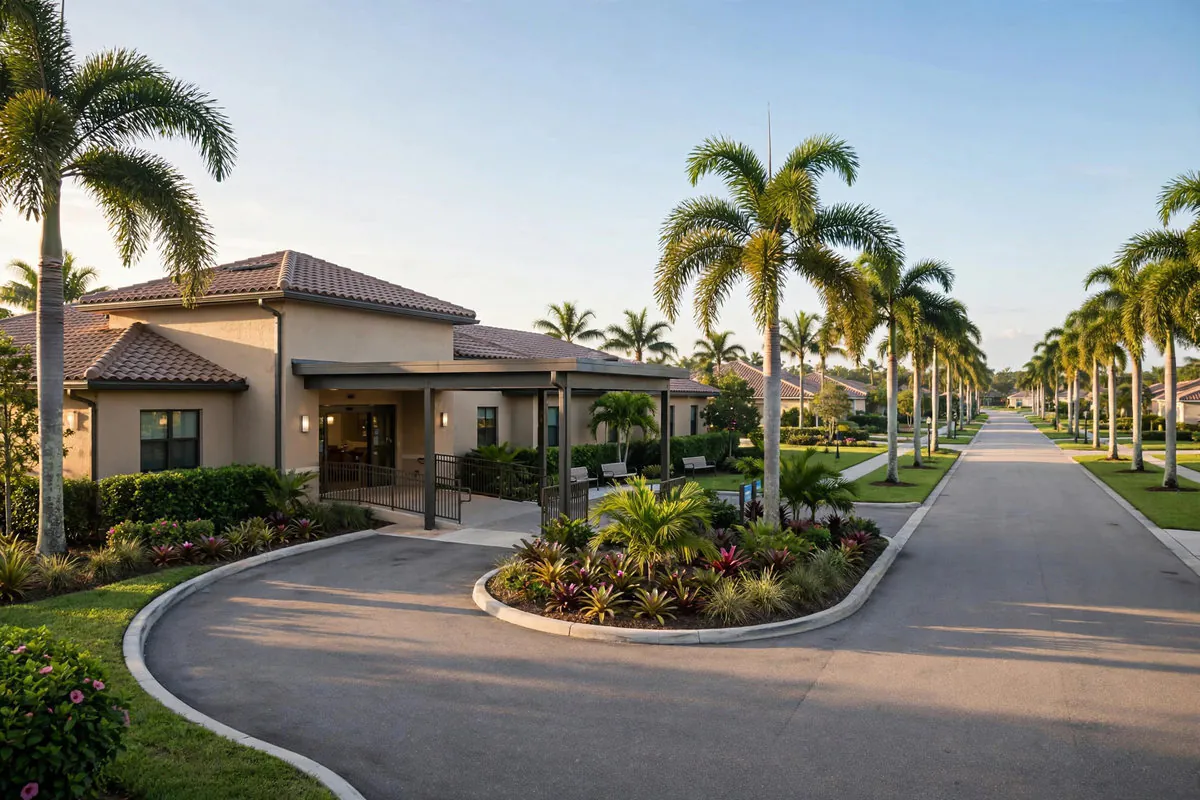
Sunrise FL Nursing Home Abuse Lawyer
Size is the first fact to understand about nursing home care in Sunrise. The city has only three certified facilities, but together they hold 467 licensed beds — an average of more than 150 beds per building, among the largest facilities in Broward County’s spoke cities. Large facilities can offer deep services, but they also run on systems: assessment systems, staffing systems, documentation systems. When a system fails, it rarely fails one resident at a time, and it rarely fails loudly. It fails in the repositioning that gets skipped on a short-staffed night shift, multiplied across a unit, until a wound or a fall makes the pattern visible in a single resident’s body.
Rafferty Domnick Cunningham & Yaffa represents Sunrise residents and their families in nursing home neglect and abuse cases under Florida chapter 400. This page is part of the firm’s Broward County nursing home abuse cluster and its statewide Florida nursing home abuse practice. It explains the signs families should act on, the records an investigation reads, and the public sources that describe each Sunrise facility’s regulatory history.
If a Sunrise resident is in immediate danger, call 911. Report suspected abuse, neglect, or exploitation of a vulnerable adult to the Florida Abuse Hotline at 1-800-962-2873. For a free consultation about care in a Sunrise facility, call (561) 516-5168.
Have Questions About Nursing Home Abuse?
Call us or request a case review by our experts.

Three Large Facilities and 467 Beds in Sunrise
Sunrise is a planned city in western Broward County, known to many visitors for its arena and shopping district, but to its residents it is a suburban community of neighborhoods built from the 1960s onward, now home to many retirees who moved there decades ago. Its three certified nursing facilities and 467 beds make it, bed for bed, one of the most concentrated nursing home markets in this cluster — compare Plantation’s 452 beds spread across four facilities, or Hollywood’s 337 across three. In Sunrise, a family’s choice is effectively among a few very large buildings.
Large census changes the risk profile. A 150-bed facility coordinates hundreds of medication passes, meals, turns, and transfers every day, across three shifts and frequent agency staffing. The law does not grade on a curve for size: each resident is owed an individualized assessment, a care plan built on it, and enough qualified staff to carry the plan out. When a Sunrise resident is injured, the investigation often focuses on whether staffing on the relevant unit and shift could actually deliver the care the plan required — a question answered by schedules and assignment sheets, not by the facility’s brochure.
County context helps families calibrate. Broward County has 33 CMS-certified nursing facilities in all. Sunrise’s three are a small count with an outsized bed share, which is why their inspection records, available through Florida HealthFinder, repay close reading by any family considering or questioning a placement there.
Warning Signs in a Large Sunrise Facility
In a big building, the most telling sign is often repetition — the same concern on consecutive visits, the same answer from different staff, the same task promised and not done. A single busy evening explains a delayed response. A month of them describes a system.
- Pressure injuries that develop or worsen while turning is charted as completed
- Falls during the night or at shift change, when supervision is thinnest
- Residents calling out unanswered, or call lights lit along a hallway
- Weight loss, dehydration, or meals recorded as eaten that the resident says were missed
- Infections — urinary, respiratory, or wound — that escalate before treatment changes
- Frequent unfamiliar agency staff who do not know the resident’s care plan
- Bruising, fearfulness, or property and funds that cannot be accounted for
Note the unit, the shift, and the date for every concern; in a large facility, patterns by unit and shift are exactly what staffing records can confirm or refute. Keep photographs and a visit log, raise concerns in writing where possible, and ask for the care plan and the most recent assessment. A facility confident in its care can produce both promptly.
How Could Nursing Home Abuse Affect Your Legal Options?
Call us or request a case review by our experts.
Investigating Systemic Failure: Staffing, Assignments, and the Chart in Sunrise Cases
A Sunrise investigation reads the chart the way an auditor reads a ledger — looking for entries that cannot all be true. Repositioning documented every two hours by a nurse who was simultaneously responsible for more residents than the task allows. Intake recorded for a resident who was at the hospital. Assessments copied forward unchanged while the resident visibly declined. Each inconsistency narrows the distance between the family’s account and the facility’s. The clinical records — wound staging, weights, labs, hospital transfer notes — then establish what the missed care cost the resident.
Staffing evidence is central in large-facility cases. Schedules, assignment sheets, and agency-staffing records show who was actually on the unit, and AHCA survey history shows whether regulators had already cited the facility for staffing, supervision, or pressure-injury care. Expert reviewers translate that record into the legal question chapter 400 asks: did the facility meet the standard of care and honor this resident’s rights, and did its failure cause this injury?
Residents’ Rights Do Not Shrink in a Big Building: § 400.022 and § 400.023
Every Sunrise resident holds the same Florida Nursing Home Residents’ Rights as a resident of the smallest facility in the state. Section 400.022 guarantees adequate and appropriate health care and protective and support services, treatment with dignity, freedom from abuse and from restraints used for discipline or convenience, and the right to present grievances without reprisal, among others. A facility’s size, census, or staffing difficulty is not a defense written into the statute — the rights are individual, and they are owed to each resident on each shift.
Section 400.023 supplies the civil action when a facility’s violation of a resident’s rights, or its failure to meet the standard of care, causes injury or death. For Sunrise families, that means the legal inquiry is concrete: identify the right or standard, prove the failure from the records, and prove the harm it caused. Cases framed that way — rather than as a general indictment of a large facility — are the ones that hold up.
Sunrise Facility Inspections and Ratings: HealthFinder, Care Compare, Ombudsman
Because Sunrise has only three certified facilities, a family can realistically read each one’s full public record. Florida HealthFinder, from the Agency for Health Care Administration (AHCA), publishes inspection and deficiency information. Medicare Care Compare publishes ratings and staffing and quality measures for certified facilities — staffing data deserves special attention in a large-building market, because it is the public trace of the very system on which care depends. The Florida Long-Term Care Ombudsman Program adds a resident-focused advocate who can visit and help resolve concerns.
Use these sources for what they are. A pattern of citations does not decide an individual case, and a clean survey does not erase one. What the public record does is tell a family whether to dig, where to dig, and whether the facility’s explanation for an injury matches what regulators have seen. A civil claim under § 400.023 remains a separate track with its own deadline, whatever an inspection finds.
Bringing a Sunrise Nursing Home Claim in the 17th Judicial Circuit
Sunrise nursing home claims are filed in Broward County’s 17th Judicial Circuit, centered on the Broward County Courthouse in Fort Lauderdale. Early work focuses on production: the complete chart, staffing and assignment records for the relevant period, and the facility’s survey history, followed by expert review. If the admission packet includes an arbitration agreement, its enforceability is assessed at the start, since it can move the case out of the circuit court altogether.
Florida deadlines for nursing home actions are strict, and in systemic-failure cases the discovery timeline — when a family first had reason to suspect neglect rather than decline — is frequently litigated. The records that answer that question are the same visit notes and photographs families are urged to keep from the first concern. An early free review preserves both the evidence and the options.
When the System Fails: Night Shifts, Short Staffing, and Sunrise Cases
Sunrise’s facilities are large — three buildings holding 467 beds — and the cases that come out of them often share a timestamp: overnight, weekends, and shift changes. That is when census stays high and staffing falls, when agency nurses who do not know the residents fill the gaps, and when the tasks most easily deferred — turning, toileting rounds, call-light response, hydration — are the tasks whose omission produces pressure injuries, falls, and dehydration. A Sunrise investigation therefore starts with the schedule as often as with the chart: who was assigned to this resident, on this unit, on this shift, and how many other residents were they carrying?
Pressure injury cases in large facilities frequently expose documentation that describes the care the plan required rather than the care the shift could deliver. Turning entries at exact two-hour intervals across a night when one aide covered a full hallway invite scrutiny, and investigators test them against staffing rosters, other residents’ records patterns, and the wound’s own clinical timeline. A wound does not read the chart. Its stage and progression are physical evidence of how long tissue went unrelieved, and expert reviewers can compare that evidence with the entries the facility made.
Fall cases follow the same structure. A resident assessed as needing assistance who falls at 3 a.m. presents questions the facility must answer with records: the supervision plan for the night, alarm use, rounding documentation, and the staffing that made the plan possible or impossible. Post-fall response matters too — assessment for injury, physician and family notification, and plan revision. A second fall under an unchanged plan is among the most difficult fact patterns a facility can defend.
None of this means large facilities are negligent by default, and it is not how a claim should be framed. It means the unit of proof in a Sunrise case is the system as applied to one resident: assessment, plan, staffing, delivery, documentation, response. Where each link holds, there is no case, whatever the outcome. Where links fail in sequence, the size of the building explains the failure without excusing it — chapter 400’s duties run to each resident individually, on the hardest shift as on the easiest.
A Sunrise family’s first steps mirror that analysis: note the dates, times, unit, and shift for every concern; photograph visible conditions lawfully; request the care plan, risk assessments, and incident reports; keep hospital records from any transfer; and have the chart and staffing reviewed together, not separately. Report suspected abuse or neglect to the Florida Abuse Hotline, and consider the Ombudsman for the resident’s immediate situation — while remembering that only a timely civil review protects a claim under § 400.023.
Agency staffing deserves a direct word in Sunrise cases, because large buildings lean on it heavily. A facility that fills a shift with temporary staff remains responsible for the care those staff deliver and for ensuring they know each resident’s plan — a float nurse cannot follow a turning schedule she was never shown. Investigations therefore ask not only who was on the unit but what they were told: assignment sheets, orientation records for agency personnel, and handoff documentation. A resident injured on a shift staffed by strangers to the building has not received a lesser standard of care in the eyes of chapter 400. The duty stayed the same; the question is whether the facility organized itself to meet it.
Sunrise families should keep one more category of paper: anything showing who was working. A name on a whiteboard, a nurse’s introduction, a schedule glimpsed at the desk — small details that let investigators match a family’s dated observations to the facility’s rosters months later, when the building’s own memory of a particular night has long since rotated away.
Why Sunrise Families Call Rafferty Domnick Cunningham & Yaffa
Large facilities defend cases with systems and paperwork, and answering them takes the same discipline: complete records, careful staffing analysis, and qualified experts. That is the work RDCY does in nursing home cases across Florida, as outlined on the Florida nursing home abuse page. For a Sunrise family, the first step is a conversation and a chart review, with a direct report of what the documents show. The firm’s verified recognition, publications, videos and social posts, results, and Google reviews are set out below in the standard form used across this cluster.
Related Nursing Home Pages
Nursing home abuse and neglect help across Broward County:
- Broward County
- Fort Lauderdale
- Pompano Beach
- Plantation
- Pembroke Pines
- Hollywood
- Sunrise
- Lauderdale Lakes
- Tamarac
- Lauderhill
- Margate
- Coconut Creek
- Dania Beach
- Wilton Manors
Professional Recognition


Recognition applies to the named attorneys and selection years. See the linked profiles for details.
GOOGLE REVIEWS
General feedback from individual five-star Google reviews:
“He is true lawyer for the people displaying great enthusiasm, professionalism and compassion.”
— Jeff
“Can not say thank you enough!”
— PJ
Sunrise FL Nursing Home Abuse FAQs
Below are answers to common questions from families with a loved one in one of Sunrise’s 3 certified nursing facilities. This information is general information about Florida law, not legal advice about a specific resident’s situation. For a review of a particular facility’s care, call (561) 516-5168.
Why does the size of Sunrise’s nursing homes matter to a legal case?
Sunrise has three certified facilities but 467 beds — buildings averaging more than 150 beds each. Size matters because the evidence changes: in a large facility, an injury often traces to staffing and systems rather than one caregiver.
The investigation therefore reads the chart together with schedules and assignment sheets for the resident’s unit and shift. A care plan that required two-hour turning means little if the roster shows the assigned staff could not physically have delivered it.
Sources: Medicare Care Compare; AHCA Florida HealthFinder Nursing Home Guide
What should I do if I find my mother soaked and unchanged during a Sunrise visit?
Get her care addressed immediately — ask for her to be cleaned and assessed, and note the time, the unit, and who responded.
Then write it down: date, time, how long staff say she had been that way, and what you were told. Photograph conditions you may lawfully photograph. A single incident may be a bad hour; the same finding on repeat visits describes a continence and turning system that is not working, with direct implications for skin breakdown and infection. Report patterns to the Ombudsman and have them reviewed.
Sources: AHCA Florida HealthFinder Facility Search; Florida Statutes Chapter 400, Online Sunshine
What rights protect a resident of a large Sunrise facility?
Exactly the same § 400.022 rights as in the smallest facility in Florida: adequate and appropriate care and protective services, freedom from abuse and from convenience restraints, grievances without reprisal, and dignified treatment.
A Sunrise facility cannot answer a rights claim with its census. The duties are individual — owed to your loved one on the night shift of a full building just as on a quiet weekday morning — and § 400.023 enforces them when a breach causes injury.
Sources: Florida Statutes Chapter 400, Online Sunshine; AHCA Florida HealthFinder Facility Search
How do I read the inspection history of a Sunrise facility?
Florida HealthFinder publishes AHCA inspection and deficiency information for each licensed facility; search the Sunrise facility by name and read several survey cycles.
In a large-building market, weight the staffing, supervision, and pressure-injury citations most heavily, and check Medicare Care Compare’s staffing data alongside them. A facility whose public staffing record is thin and whose citations repeat is telling you, in advance, the system your loved one’s care depends on.
Sources: AHCA Florida HealthFinder Facility Search; AHCA Florida HealthFinder Nursing Home Guide
The Sunrise chart shows turning every two hours, but the wound kept worsening. What does that mean?
It means one of the two records is wrong — the wound’s clinical progression or the turning log — and wounds do not fabricate timelines.
Investigators compare the entries against staffing rosters, assignment sheets, and the other demands on the charting nurse, and clinical experts assess whether the wound’s staging matches the care described. Perfectly regular entries across a short-staffed night are a recognized pattern in Sunrise cases. The discrepancy itself often becomes the center of the claim.
Sources: Medicare Care Compare; Florida Statutes Chapter 400, Online Sunshine
My father fell at night in a Sunrise facility. What records matter most?
The fall-risk assessment and night supervision plan, alarm and rounding documentation, the staffing roster and assignment sheet for that shift, the incident report, and the post-fall response: injury assessment, physician and family notification, and any change to the plan.
Night is when a large facility’s staffing is thinnest, so the roster either supports the plan or exposes it. If he had fallen before under the same plan, obtain the earlier incident records as well — notice plus inaction is a powerful combination.
Sources: Florida Statutes Chapter 400, Online Sunshine; AHCA Florida HealthFinder Facility Search
Where would a Sunrise nursing home case be filed?
In Broward County’s 17th Judicial Circuit, at the Broward County Courthouse in Fort Lauderdale, east of Sunrise.
If the facility invokes an arbitration clause from the admission packet, the forum fight comes first, because an enforceable clause moves the case to a private arbitrator. Counsel reviews that document at intake. Either way, the evidentiary core is the same: the resident’s chart read alongside the staffing that was supposed to deliver the care it describes.
Sources: Florida Statutes Chapter 400, Online Sunshine; Florida Courts — Circuit Trial Courts
Does it matter if the staff who cared for my loved one in Sunrise were agency nurses?
Not to the facility’s responsibility. A Sunrise facility that fills a shift with temporary staff still owes the resident the full standard of care, including staff who know the care plan.
Agency staffing is, however, evidentially important: assignment and orientation records show what float staff were told, and a pattern of unfamiliar caregivers supports the family’s account of missed, generic care. Preserve the dates of concern precisely, because agency rosters are harder to reconstruct later.
Sources: Florida Statutes Chapter 400, Online Sunshine; AHCA Florida HealthFinder Facility Search
Can the Ombudsman help with a problem in a Sunrise facility?
Yes — the Florida Long-Term Care Ombudsman Program advocates for residents inside facilities, visiting, listening, and working to resolve care and rights concerns at no cost.
In a building of 150-plus beds, an ombudsman gives an individual resident a named advocate, which is no small thing. The program cannot litigate or recover damages, so a serious injury in Sunrise still requires a § 400.023 review, which runs on a deadline independent of any ombudsman or AHCA process.
Sources: AHCA Florida HealthFinder Nursing Home Guide; Florida Statutes Chapter 400, Online Sunshine
How long does a Sunrise family have to bring a nursing home claim?
Florida’s deadlines are strict, and in systemic-failure cases the disputed question is often when the family should first have suspected neglect rather than natural decline — a question the family’s own visit notes help answer.
Do not spend that time waiting on a facility’s internal review. A free consultation at the first serious concern preserves the chart, the staffing records, and the witnesses, and leaves the decision to file where it belongs: with the family, on full information.
Sources: Medicare Care Compare; Florida Statutes Chapter 400, Online Sunshine
Related Articles
- Documenting Nursing Home Abuse: Building a Strong Legal Case
- The Consequences of Understaffing in Florida Nursing Homes
- Florida Nursing Home Staffing Requirements
- Arbitration Clauses in Florida Nursing Home Admission Contracts
- Medication Mismanagement in Nursing Facilities: Legal Recourse
- How to File a Wrongful Death Claim Against a Nursing Home?
Need Help With a Case Involving Nursing Home Abuse?
Call us or request a case review by our experts.


