
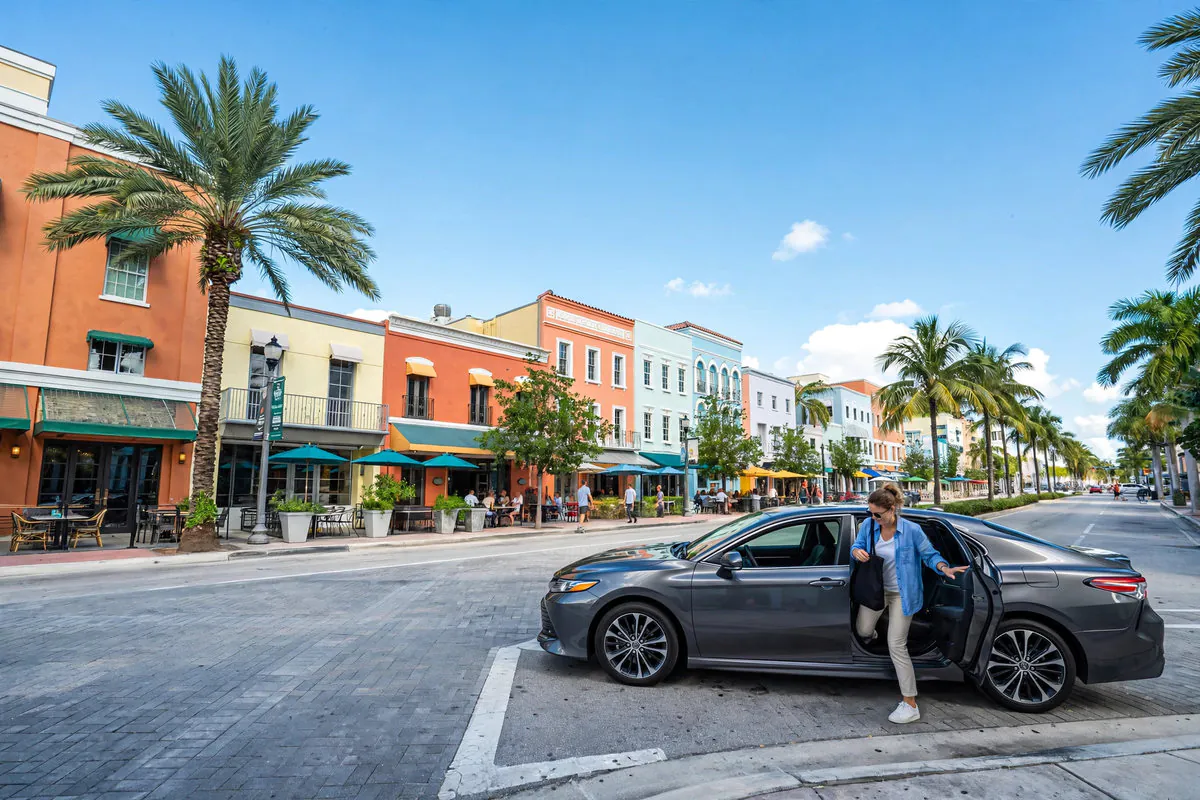
West Palm Beach FL Rideshare Accident Lawyer
Rideshare cars are part of the traffic fabric of West Palm Beach: pickups at Palm Beach International Airport (PBI), drop-offs along Clematis Street and Rosemary Square, rides across the bridges to Palm Beach, and a constant flow along I-95 and Okeechobee Boulevard. When one of those rides ends in a crash, the injured person quickly discovers that a rideshare claim is not a normal car accident claim — the insurance that applies depends on what the driver’s app was doing at the exact second of impact.
This page explains how rideshare accident claims work in West Palm Beach and Palm Beach County: Florida’s transportation network company insurance periods under §627.748, who can be liable, what compensation a claim can pursue, and how a claim is filed in the Fifteenth Judicial Circuit. It builds on our statewide Florida Uber accident practice and sits within our broader Florida motor vehicle accident work.
The single most important fact in any West Palm Beach rideshare case is the driver’s app status — off, on and waiting, or carrying a matched trip. That status selects the insurance policy, and getting it established early, before accounts are deactivated and records scatter, is where these claims are won or lost.
Have Questions About Rideshare Accidents?
Call us or request a case review by our experts.

Why You Need an Experienced Rideshare Accident Attorney in West Palm Beach
In an ordinary West Palm Beach crash, the at-fault driver’s personal policy is the starting point. In a rideshare crash, the starting point is a statute. Florida §627.748 sets the insurance a transportation network company (TNC) and its drivers must carry, and the coverage changes across three periods — which means two crashes on the same Okeechobee Boulevard corner can be insured completely differently.
Layered on top of the TNC coverage are the driver’s personal auto policy (which typically excludes commercial rideshare driving), Florida’s no-fault PIP benefits, any other involved driver’s coverage, and uninsured/underinsured motorist protection. Insurers know this stack is confusing and use the confusion: each carrier points at another and waits for the injured person to give up or accept a fraction.
An attorney who handles rideshare cases regularly knows how to pin down app status through the trip record, force each carrier to state its position, and sequence the claims so no deadline or coverage layer is forfeited. That is the practical difference experience makes in a Palm Beach County rideshare case.
Who Is Liable in a West Palm Beach Rideshare Accident?
Liability starts with negligence: the rideshare driver who ran the light on Dixie Highway, the other driver who turned across traffic on Southern Boulevard, or both. Florida’s comparative fault framework in chapter 768 allocates responsibility among everyone whose negligence contributed, and each share matters to the recovery.
The rideshare company itself is usually not the direct defendant — its drivers are independent contractors — but its statutory insurance is the deep coverage in most serious cases. Which policy responds depends on the period: the driver’s own coverage when the app is off; TNC-provided contingent liability coverage when the app is on and the driver is waiting; and the TNC’s $1 million liability coverage once a ride is accepted through drop-off, together with uninsured/underinsured motorist protection the statute requires in that period.
Other defendants appear in the right facts: a bar or venue in a dram-shop-adjacent fact pattern is rare in Florida, but a vehicle owner, an employer whose worker was driving, or a government entity responsible for a dangerous road condition can each carry part of a West Palm Beach claim. A complete investigation pleads the case the evidence supports, not the simplest version of it.
How Could Rideshare Accidents Affect Your Legal Options?
Call us or request a case review by our experts.
What Compensation Can a West Palm Beach Rideshare Claim Pursue?
A rideshare claim can pursue the full range of Florida accident damages: emergency and ongoing medical care, rehabilitation, lost wages and diminished earning capacity, property loss, and noneconomic losses such as pain, suffering and loss of enjoyment of life. Serious injuries treated at St. Mary’s Medical Center or Good Samaritan Medical Center generate the records that document the medical side of that picture.
Florida’s no-fault system shapes the first dollars: PIP benefits cover a portion of medical bills and lost wages regardless of fault, subject to the 14-day treatment rule and the emergency medical condition framework. Beyond PIP, a claim against the at-fault side generally requires a permanent injury or another statutory threshold injury — one reason early, thorough medical documentation matters.
The available insurance ceiling depends on the app period, which is why the $1 million TNC period changes a case’s posture entirely. No honest lawyer quotes a value before the medical picture and the coverage stack are both established; what can be promised is a claim built to reach every layer that applies.
How to File a Rideshare Accident Claim in West Palm Beach
Start at the scene if you can: call 911, get the crash report number from the responding agency, photograph the vehicles and the rideshare app’s trip screen, and save the digital receipt — it shows the driver, the route and the trip times that fix the insurance period. Then get medical care promptly; Florida PIP’s 14-day window makes delay expensive as well as unhealthy.
Report the crash through the rideshare app and to your own insurer, but keep statements factual and brief until the coverage picture is clear. The claim is then presented to the correct carrier — TNC insurer, driver’s insurer, or the other driver’s — with the trip record, the crash report, medical documentation and a damages analysis.
If the claim cannot be resolved, suit is filed in Palm Beach County — in the Fifteenth Judicial Circuit for claims above the county court threshold — within the limitations period. Most West Palm Beach rideshare claims settle, but they settle at the value the filed-case threat supports.
Common Challenges in Palm Beach County Rideshare Cases
The signature dispute is app status. A driver whose app was between trips, or who accepted a ride moments before impact, creates a genuine factual fight over which policy applies — and each insurer has an incentive to place the crash in the other’s period. Trip data, timestamps and the digital receipt usually settle it, which is why preserving them immediately matters.
Independent-contractor status is the second wall: the TNC will say the driver is not its employee, so the case must be built on the statutory insurance rather than vicarious liability. Comparative fault arguments are the third — expect the defense to assign the injured person, or another driver, the largest share it can argue under chapter 768.
Finally, rideshare passengers often assume the app’s involvement guarantees payment. It does not. Coverage is real but contested, PIP thresholds still apply, and an unrepresented claimant negotiating against three carriers at once starts at a structural disadvantage.
How the Insurance Period Is Proved in a West Palm Beach Claim
Because coverage turns on app status, proving the period is an evidence exercise. The passenger’s digital receipt shows the trip’s start and end times; the crash report fixes the collision time; and the TNC’s trip data — obtained by demand and, if necessary, in litigation — confirms when the ride was requested, accepted and completed. Aligned, those three sources usually end the argument.
Edge cases still arise: a driver who had accepted the next ride while finishing the current one, a driver logged into two apps at once, or a crash in the PBI pickup queue moments after drop-off. Florida’s statute keys coverage to the TNC whose trip was accepted, so dual-app facts require care — the accepted trip, not merely the open app, is what carries the $1 million period.
Witnesses and vehicle telematics can corroborate the timeline, and the responding officers’ body-camera and dispatch records sometimes capture the driver’s own account of what the app was doing. Building that proof early is unglamorous work, but in a West Palm Beach rideshare claim it is frequently the whole case.
Rideshare Crashes at PBI and Across Palm Beach County
Palm Beach International Airport concentrates rideshare traffic: designated pickup areas, drivers circling for matches, and passengers crossing lanes with luggage. Crashes in and around the airport’s roadways raise the same period questions in a compressed space — a driver waiting in the queue is in the waiting period until a match is accepted, and the $1 million period begins at acceptance, not at the curb.
Beyond the airport, the county’s rideshare volume follows its nightlife and events: Clematis Street weekends, Kravis Center performances, spring training and festival traffic. Each surge puts more app-on drivers on roads like Belvedere Road and Australian Avenue, mixing with drivers who have never used a rideshare app. For an injured person, the geography matters less than the proof — but local counsel who knows where these crashes cluster also knows which cameras, agencies and witnesses to move on first.
County resources for crash victims sit inside the same Fifteenth Circuit system described above, and treatment records will typically come from the county’s trauma and hospital network. A claim organized around the airport or downtown facts — report, trip record, timestamps — travels the same statutory road as any other Palm Beach County rideshare claim, only faster-moving.
What West Palm Beach Rideshare Passengers Usually Ask First
Most passengers ask a version of the same question: I did everything right — I took a rideshare instead of driving — so why is this complicated? The honest answer is that the system was designed around the driver’s employment status rather than the passenger’s innocence, and the statute’s insurance periods are the patch Florida built over that design. Inside an accepted trip, the patch is strong: $1 million of liability coverage and required UM protection. The work is proving the trip and the fault, in that order.
Passengers also ask whether rating, tipping or in-app complaints affect the claim. They do not — the claim rests on the crash report, the trip record and the medical documentation. What does help is keeping the app installed and the account active until the trip data is secured, and declining the insurer’s first call-center offer until the medical picture is complete.
Settlements, Liens and the Practical End of a West Palm Beach Rideshare Case
When a rideshare claim resolves, the gross figure is not what the injured person keeps. PIP offsets, health insurer or hospital liens, Medicare or Medicaid reimbursement rights in applicable cases, and the written fee and cost agreement all come out of the recovery under their own rules. Hospital liens in Palm Beach County are a recurring feature of serious crash cases, and the amounts asserted are checked against the actual charges and payments rather than accepted as presented.
Negotiating those liens down is part of the representation, and it is one of the quieter places local experience pays: the same hospital systems and payers appear in case after case. The file is not closed until every lien is resolved or accounted for in writing, because an unresolved lien follows the claimant, not the insurer. A West Palm Beach rideshare settlement should end the matter — all of it.
A Note on Evidence in Palm Beach County Rideshare Cases
Rideshare evidence has a shorter half-life than ordinary crash evidence. App data sits behind a company’s retention practices, pickup-area and roadway camera footage is overwritten on cycles measured in days or weeks, and the other driver’s account hardens once an insurer takes it. The crash report starts the file, but the trip record, the timestamps and any available video are what separate a proved period from an argued one. Moving on that evidence in the first weeks — while the PBI cameras, the app data and the witnesses are all still reachable — is the least visible and most consequential work in a West Palm Beach rideshare claim.
Why Choose RDCY for a West Palm Beach Rideshare Case
Rafferty Domnick Cunningham & Yaffa is a Palm Beach County trial firm. Its motor vehicle practice — including its statewide Florida Uber accident work — handles the insurance-period analysis, the multi-carrier negotiation and, when necessary, the Fifteenth Circuit lawsuit as one continuous case rather than a series of handoffs.
For a West Palm Beach client, the firm is local: the courthouse, the hospitals where treatment records will come from, and the corridors where these crashes happen are its home ground. Calls are answered at (561) 516-5168, and the initial review of a rideshare claim is free.
If the trip record supports the claim, you will be told which coverage applies and what the case can pursue. If it does not, you will be told that too — before you have signed anything or let a deadline pass.
Related Pages
Rideshare and related Palm Beach County help:
- Motor Vehicle Accidents
- Florida Uber Accidents
- Florida Lyft Accidents
- Uber Sexual Assault Litigation
- West Palm Beach Medical Malpractice
- West Palm Beach Nursing Home Abuse
Professional Recognition


Recognition applies to the named attorneys and selection years. See the linked profiles for details.
GOOGLE REVIEWS
General feedback from individual five-star Google reviews:
“DCY is amazing.”
— Katrina
“Great Firm would Highly Recommend”
— Mark
West Palm Beach FL Rideshare Accident FAQs
These answers are general information about Florida rideshare accident law as it applies in West Palm Beach and Palm Beach County — not legal advice about a specific crash. The driver’s app status and your facts control which coverage applies.
Which insurance applies if my Uber or Lyft crashed in West Palm Beach?
It depends on the driver’s app status at impact, under Florida Statutes §627.748. App off: the driver’s personal policy. App on and waiting for a match: TNC contingent liability coverage of at least $50,000 per person / $100,000 per occurrence for bodily injury and $25,000 for property damage. Ride accepted through drop-off: the TNC’s $1 million liability coverage, plus required uninsured/underinsured motorist protection.
That is why the trip record and digital receipt are the first evidence to preserve in a Palm Beach County rideshare case. Chapter 627 contains the full TNC framework, and the responding carrier is determined by matching the crash timestamp to the trip period.
Sources: Florida Statutes § 627.748 — Transportation Network Companies (Florida Senate) · Florida Statutes § 627.736 — PIP Benefits (Florida Senate)
I was a passenger in a rideshare that crashed on I-95 near West Palm Beach — who pays my medical bills?
If the at-fault driver was uninsured, the uninsured motorist coverage §627.748 requires during the trip period becomes central. The sequence — PIP first, liability claim second, UM if needed — is standard, but each step has its own notice requirements.
Sources: Florida Statutes § 627.736 — PIP Benefits (Florida Senate) · Florida Statutes § 627.748 — Transportation Network Companies (Florida Senate)
How long do I have to file a rideshare accident lawsuit in Palm Beach County?
Two years passes quickly when three insurers are exchanging letters, and some claims — for example against a government entity over road conditions — carry earlier notice deadlines. Treat the crash date as the start of a short clock, not a comfortable one.
Sources: Florida Statutes § 95.11 — Limitations of Actions (Florida Senate) · Florida Statutes § 627.748 — Transportation Network Companies (Florida Senate)
Can I sue Uber or Lyft directly for my West Palm Beach crash?
Usually the claim runs against the negligent driver and the insurance the statute requires, rather than against the TNC as an employer, because drivers are classified as independent contractors. The practical recovery source in a serious case is the TNC’s $1 million trip-period policy, which §627.748 mandates precisely so an injured person is not limited to a driver’s personal coverage.
The Florida Bar’s public resources explain how independent-contractor classification affects claims generally. What matters in your case is less the company’s label than which policy the trip period triggers and whether the damages reach it.
Sources: Florida Statutes § 627.748 — Transportation Network Companies (Florida Senate) · Florida Statutes § 768.81 — Comparative Fault (Florida Senate)
The rideshare driver who hit my car in West Palm Beach was between rides — am I covered?
Your own uninsured/underinsured motorist coverage may also apply if the total available coverage is too small for the harm. Chapter 627’s TNC section is the controlling text for which layer responds first.
Sources: Florida Statutes § 627.748 — Transportation Network Companies (Florida Senate) · Florida Statutes § 627.727 — Uninsured Motorist Coverage (Florida Senate)
What should I do right after a rideshare accident in West Palm Beach?
Seek treatment within 14 days to protect PIP benefits, report the crash in the app, and be cautious with recorded statements until the coverage stack is understood. The Florida Bar publishes general guidance on what to do after an accident; a free review at (561) 516-5168 can map your specific claim.
Sources: Florida Statutes § 627.736 — PIP Benefits (Florida Senate) · Florida Statutes § 95.11 — Limitations of Actions (Florida Senate)
How does Florida’s comparative fault rule affect a Palm Beach County rideshare claim?
Chapter 768 allocates fault among everyone whose negligence contributed — the rideshare driver, another driver, and potentially the injured person. Under Florida’s modified comparative fault rule, a claimant more than 50 percent at fault cannot recover from the other side, and recovery is reduced by the claimant’s own share.
Expect each insurer to argue the largest possible share onto someone else. The crash report, vehicle damage, scene evidence and witness accounts are what keep an allocation honest, which is another reason early evidence preservation drives outcomes in these cases.
Sources: Florida Statutes § 768.81 — Comparative Fault (Florida Senate) · Florida Statutes § 95.11 — Limitations of Actions (Florida Senate)
What if the other driver who caused my West Palm Beach rideshare crash was uninsured?
Outside the trip period — app on but waiting — the required coverage is the contingent liability minimums, and your own UM may become the primary protection. Identifying which period the crash fell in remains the threshold task either way.
Sources: Florida Statutes § 627.727 — Uninsured Motorist Coverage (Florida Senate) · Florida Statutes § 627.748 — Transportation Network Companies (Florida Senate)
Where will my West Palm Beach rideshare case be filed if it does not settle?
Filing must occur within the §95.11 limitations period, and the complaint names the negligent drivers — with the TNC’s insurer responding under the statutory policy — rather than the platform as an employer in the ordinary case.
Sources: Florida Statutes § 47.011 — Venue (Florida Senate) · Florida Statutes § 95.11 — Limitations of Actions (Florida Senate)
What does it cost to have RDCY handle a West Palm Beach rideshare claim?
The Florida Bar’s public pages describe how contingency arrangements work in Florida generally. In a specific case, ask for the agreement, the percentage, and how costs are handled, and expect straight answers to all three.
Sources: Florida Statutes § 95.11 — Limitations of Actions (Florida Senate) · Florida Statutes § 768.81 — Comparative Fault (Florida Senate)
Related Articles
- Understanding Florida’s Unique Insurance Policies for Rideshare Accidents: A Comprehensive Guide
- What to Know about Ridesharing Car Accidents and Insurance Policies
- There Was an Accident During My Rideshare—What Do I Do Next?
- Am I Entitled to Compensation if a Rideshare Driver Hit my Car?
- I Was Struck by a Rideshare Driver as a Pedestrian. Do I Have a Claim?
Need Help With a Case Involving Rideshare Accidents?
Call us or request a case review by our experts.


