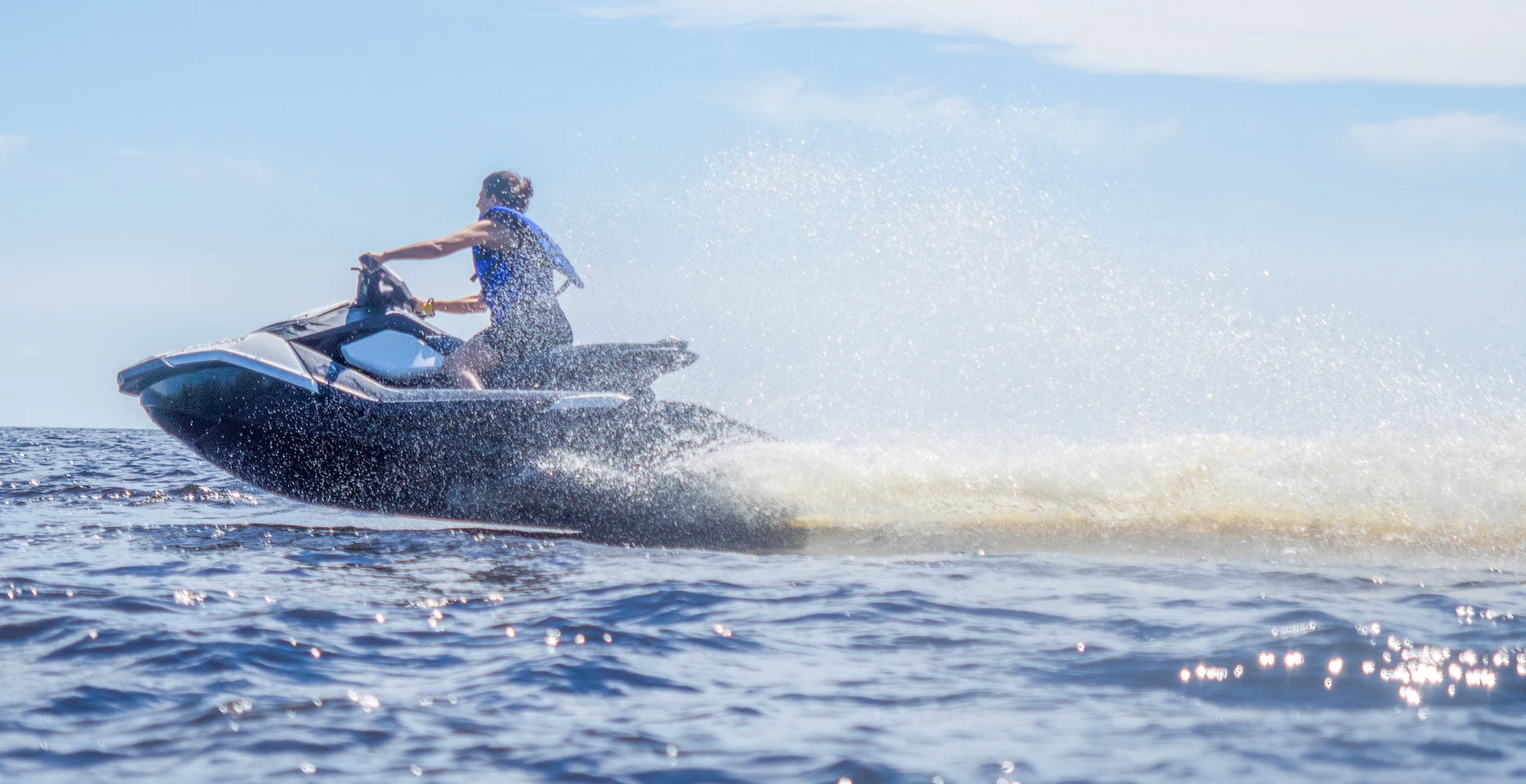
Florida Jet Ski Accident Lawyer
Exploring the waterways of Florida by jet ski can be an exhilarating experience. Unfortunately, hidden hazards and irresponsible behavior from others can turn an excursion into a disaster. If you suffered injuries in a jet ski accident in Florida, it is a good idea to consult a jet ski accident lawyer before too much time passes. You could be entitled to compensation to cover your medical expenses and other losses, such as pain and suffering. An attentive personal injury lawyer at Rafferty Domnick Cunningham & Yaffa (RDCY) can protect your rights so you can claim fair restitution.
Personal watercraft combine motorcycle-like speed with none of a motorcycle’s protection: no brakes, steering that depends on throttle, and riders exposed to direct water impact and to other vessels. Florida’s coasts, the Intracoastal Waterway, and the lakes and rivers around Palm Beach County put powerful rental machines in the hands of first-time operators every day of the year. This page explains who can be liable, what Florida law requires of operators and rental businesses, and how a claim works. It sits within our Florida motor vehicle accident practice, which covers recreational-vehicle injuries of every kind.
Florida records hundreds of personal watercraft accidents in a typical year, and the state consistently ranks among the nation’s leaders in boating accidents overall — a predictable result of year-round boating, heavy visitor traffic, and a rental market that puts beginners on powerful machines. The law discussed below is how responsibility for those accidents gets sorted out.
Have Questions About a Florida Jet Ski Accident?
Call us or request a case review by our experts.

How Jet Ski Accidents Happen in Florida
The collision patterns are consistent. Two personal watercraft collide when an inexperienced rider fixates on the craft ahead and — because a jet ski cannot steer without throttle — cannot turn away in time. A rider is thrown after striking a wake, a channel marker, or a submerged hazard at speed. A rental group led across a busy channel meets boat traffic its guide should have avoided. Alcohol, which Florida law prohibits combining with vessel operation just as with driving, runs through a large share of serious cases.
Ejection injuries are the signature harm: riders hit the water at speed, strike the craft itself, or are struck by a following watercraft. The result is a distinctive injury profile — head and spinal injuries, fractures, internal injuries, and near-drowning — out of proportion to the size of the machine. Understanding the mechanism matters because it directs the investigation: operator conduct, training, alcohol, machine condition, and the decisions of whoever put that rider on that craft.
Parties Who Could Be Liable for a Jet Ski Accident Injury
International tourists and other visitors often rent jet skis in Florida from resort properties, adventure outfitters, or private businesses advertising online. If these providers do not take adequate precautions, they can be held liable for the harm their negligence causes. A Florida jet ski accident lawyer can assist in pursuing a claim arising from factors such as improper maintenance of the jet ski or other watercraft, failure to label hazards such as rocks in the waterway, others operating watercraft under the influence of alcohol or drugs, mechanical defects in the watercraft involved, and other boaters failing to follow the rules and exercise reasonable caution.
Depending on the cause, more than one party can be held accountable for the collision — an operator, an owner, a rental business, a tour operator, and a manufacturer can all sit in the same case. If the accident victim’s own conduct contributed to the cause, that comparative fault may reduce the amount recovered, but it does not prevent recovery from the other responsible parties unless the victim’s share exceeds half. The investigation’s job is to assemble the whole picture before anyone’s insurer narrows it.
How Could a Jet Ski Accident Affect Your Legal Options?
Call us or request a case review by our experts.
Florida Boating Law: The Rules That Frame the Claim
Florida’s boating code, chapter 327, sets the duties every operator and rental business works under. Reckless or careless operation is prohibited; boating under the influence carries criminal penalties and is compelling evidence of negligence; personal watercraft carry their own operating rules; and accidents causing injury or death must be reported and are investigated by state or local marine officers. Federal navigation rules — lookout, safe speed, and right-of-way — apply on the same waters.
These rules do the civil case’s heavy lifting. A claim is built by comparing what each party did against what the code and the navigation rules required: the operator who never looked before turning, the livery that rented without the required instruction, the owner who lent a craft with a known defect. Violations are not technicalities; on the water, they are how people get hurt.
Rental Companies and the Duties They Owe Riders
Rentals dominate Florida jet ski injuries, and the business model creates predictable failures: minimal instruction for a machine that behaves counterintuitively, no real assessment of whether the renter can swim or has ever operated a vessel, groups sent out in conditions or traffic beyond their ability, and machines returned to service with steering or throttle problems noted but never fixed. Florida law imposes instruction and safety duties on liveries precisely because the legislature recognized this pattern.
The paperwork signed at the dock — rental agreements, waivers, insurance elections — is part of the case, but it is not the whole case. A waiver does not manufacture training that never happened, and it does not reach the claims against other operators or a manufacturer. Rental cases are won on the gap between what the business was required to do and what it actually did in the fifteen minutes before the rider left the dock.
Damages Available After a Jet Ski Accident
The exposed sides of a jet ski leave riders unprotected in a collision, and riders often suffer much more severe injuries than those in boats or other watercraft. If negligence caused the accident, the victim can be entitled to compensation for economic losses such as medical expenses and time missed from work. Travelers forced to remain in Fort Lauderdale, Orlando, Miami, or Palm Beach County while recovering can also recover travel and lodging expenses the injury imposed, and damages can address effects anticipated in the future as well as losses already incurred.
Noneconomic damages — pain and suffering, emotional anguish, scarring, and lost enjoyment of life — are often the larger share in serious watercraft cases, and near-drowning injuries require a future-care analysis that accounts for the cognitive and physical consequences of oxygen deprivation. Fatal accidents support wrongful death claims for the surviving family. The damages case is documented with treating providers and, where the injury is permanent, life-care and economic experts, so that settlement talks measure the real loss.
Injuries Commonly Caused by Jet Ski Accidents
Personal watercraft injuries follow the physics of ejection at speed. Riders thrown into the water column or against the craft suffer traumatic brain injuries and concussions, spinal fractures and cord injuries, broken ribs and limbs, and internal injuries to the chest and abdomen. Lacerations from the craft’s edges and from propellers of following vessels are common, and drowning and near-drowning remain the gravest risk — the CDC identifies drowning as a leading cause of unintentional injury death, and minutes of oxygen deprivation can produce permanent brain injury in a survivor.
Passengers are injured at least as often as operators, and they control nothing: a passenger’s claim typically runs against the operator, the rental business, and any other responsible party. Children appear in these cases as passengers and as swimmers struck in designated areas, which is why the investigation always maps where every person was — on a craft, in the water, or on a dock — when the sequence began.
The medical profile drives the legal one. These cases are valued on documented treatment and prognosis, so consistent follow-up care is both a health necessity and the backbone of the damages claim.
What To Do After a Jet Ski Accident in Florida
Medical care comes first, including evaluation for head, spine, and internal injuries that adrenaline can mask. Make sure the accident is reported to the appropriate marine authority and obtain the report information. Photograph the watercraft, your injuries, and the location; save the rental agreement, instruction materials, and receipts; and record the names of the rental staff, guides, and witnesses while memories are fresh.
Then slow the paperwork down. Do not give the rental company’s insurer a recorded statement, and do not sign releases or accept a fast settlement before your prognosis is clear. Watercraft are repaired and re-rented, and marina video is overwritten — the sooner an investigation opens, the more of the case survives to be proven.
Contact a Knowledgeable Florida Jet Ski Accident Attorney at RDCY
Some people feel that filing a claim could be overwhelming while dealing with a personal injury. But it is only fair to shift the burden to those responsible for causing the accident — and bringing the issue to light can help prevent others from suffering a similar fate. It is a good idea to talk to a Florida jet ski accident lawyer before answering questions from insurance companies and investigators.
RDCY handles watercraft injury claims for Florida residents and for visitors injured here on vacation, coordinating evidence preservation in Florida while treatment continues at home. For a free consultation with Rafferty Domnick Cunningham & Yaffa, call today — the review covers liability, the rental business’s duties, the deadlines, and what your claim may be worth.
And when the honest answer is that a claim is weak — because the evidence genuinely points to an unavoidable accident — we say that too, at no charge, with the reasoning explained. What no injured rider should do is guess: the duties on the water are specific, the records exist, and a claim’s real strength can only be judged once both are on the table.
Related Recreational Vehicle Pages
- Florida Motor Vehicle Accident Lawyer
- Golf Cart Accidents in Florida
- Scooter Accidents in Florida
- Florida Boat Accident Lawyer
- Florida Personal Injury Lawyer
Professional Recognition


Recognition applies to the named attorneys and selection years. See the linked profiles for details.
Frequently Asked Questions About Florida Jet Ski Accidents
Answers to common questions about liability, rental companies, waivers, deadlines, and compensation after a personal watercraft accident in Florida. This is general information, not legal advice about a specific case.
Who can be liable for a jet ski accident in Florida?
Liability can rest with several parties. Another operator who drove recklessly, too fast for the conditions, or under the influence is the most direct defendant. A rental company can be liable for handing a powerful personal watercraft to an untrained rider, failing to give required safety instruction, or renting out a mechanically defective machine. The owner who lent the craft, a tour operator who led riders into hazards, and the manufacturer of a defective watercraft can also share responsibility.
Florida’s comparative fault statute apportions damages among everyone whose negligence contributed, so a proper investigation identifies each of them rather than stopping with the person at the throttle.
Sources: Florida Statutes § 327.33, Online Sunshine; Florida Statutes § 768.81, Online Sunshine.
What Florida laws govern jet ski operation?
Chapter 327 of the Florida Statutes regulates vessels, including personal watercraft. It prohibits reckless operation — weaving through traffic, jumping wakes dangerously close to other vessels, and similar conduct — and it imposes personal-watercraft-specific rules on matters such as operating hours, age, and required safety equipment. Federal navigation rules enforced by the Coast Guard apply on navigable waters at the same time.
A violation of these rules is evidence of negligence in a civil claim. Where an accident report was filed, the investigating agency’s findings about which rules were broken often frame the liability argument from the start.
Sources: Florida Statutes § 327.39, Online Sunshine; U.S. Coast Guard Boating Safety: Federal Laws.
What if the accident involved a rented jet ski?
Rental cases turn on the livery’s duties. Florida law requires rental operations to give renters pre-ride instruction and to meet safety and insurance requirements, and a business that rents a high-powered craft to someone it never trained — or whose impairment or inexperience was obvious — can be liable for the predictable result. The rental contract matters too: waivers and insurance elections signed at the dock are frequently challenged and do not protect a business from its own negligence in every circumstance.
Preserve everything signed at rental, the instruction (or lack of it) you were given, and the craft’s condition. Those details usually decide the rental side of the case.
Sources: Florida Statutes § 327.39, Online Sunshine; Florida Fish and Wildlife Conservation Commission: Boater Safety Education.
What damages are available after a Florida jet ski accident?
An injured person can pursue economic damages — emergency and hospital care, surgery, rehabilitation, follow-up treatment, lost wages, and diminished earning capacity — and noneconomic damages for pain and suffering, mental anguish, scarring or disfigurement, and loss of enjoyment of life. Visitors injured on vacation may also recover the costs the injury imposed on the trip, including extended lodging and changed travel while they recover away from home.
In a fatal accident, Florida’s wrongful death law allows surviving family members to pursue the losses caused by the death. Drowning and near-drowning injuries deserve particular care in valuation: brain injury from oxygen deprivation can produce lifelong needs that early settlement offers rarely reflect.
Sources: Florida Statutes § 768.81, Online Sunshine; CDC: Drowning Facts and Prevention.
How long do I have to file a jet ski accident claim in Florida?
Florida’s limitations statute generally gives an injured person two years from the date of the accident to file a personal injury lawsuit based on negligence, and wrongful death claims carry a two-year period from the date of death. Different rules and shorter deadlines can apply where a government entity is involved or where the accident falls under maritime law principles.
The practical deadline is shorter than the legal one. Rental watercraft are repaired and rented again, surveillance and marina records are overwritten, and tourist witnesses scatter. An early investigation preserves the proof while it still exists.
Sources: Florida Statutes § 95.11, Online Sunshine; Florida Statutes § 327.301, Online Sunshine.
Does it matter that I signed a waiver at the rental dock?
It matters, but it is rarely the end of the case. Florida courts scrutinize recreational waivers, and a waiver generally does not excuse a business’s own negligence in maintaining its equipment, training its renters, or following the safety rules the legislature imposed on liveries. A waiver also has no effect at all on claims against other responsible parties — another operator, an owner, or a manufacturer.
Bring the waiver to your lawyer rather than assuming it decides anything. What it says, how it was presented, and what the business did or failed to do around it are all part of the analysis.
Sources: Florida Statutes § 327.39, Online Sunshine; Florida Statutes § 768.81, Online Sunshine.
What if I was partly at fault for the jet ski accident?
You may still recover. Florida follows a modified comparative fault system: your damages are reduced by your percentage of fault, and only a claimant found more than 50 percent at fault is barred from recovery. In watercraft cases, fault is genuinely comparative — operators have duties to keep a lookout, maintain a safe speed, and follow the navigation rules, and more than one operator usually contributed something.
Rental companies and insurers often overstate a renter’s share, pointing to inexperience the business itself was obliged to correct with instruction. Fault is apportioned on evidence — reports, witnesses, and the craft’s condition — not on the first account an adjuster writes down.
Sources: Florida Statutes § 768.81, Online Sunshine; Florida Statutes § 327.33, Online Sunshine.
Should a jet ski accident be reported, and to whom?
Yes. Florida law requires the operator of a vessel involved in an accident causing injury, death, or significant property damage to report it, and accidents are investigated by the Florida Fish and Wildlife Conservation Commission, a sheriff’s office, or local marine patrol depending on the waters. The official report records the operators, conditions, and apparent violations while they are fresh.
Get medical care first — head, spine, and internal injuries are common in personal watercraft collisions and are not always obvious on the dock. Then make sure a report exists, photograph the craft and your injuries, and keep the rental paperwork. Each of those items becomes evidence.
Sources: Florida Statutes § 327.301, Online Sunshine; Florida Fish and Wildlife Conservation Commission: Boater Safety Education.
Can I bring a claim if I was injured while visiting Florida on vacation?
Yes. An injury that happens in Florida waters is governed by Florida law, and visitors — including international tourists — can pursue claims against the operators, rental businesses, and owners responsible, on the same terms as residents. The practical challenges are logistical: treatment continues at home, witnesses are travelers too, and the rental business holds most of the records.
That is precisely why early Florida counsel matters in visitor cases. Evidence is gathered and preserved here while you recover at home, deadlines are tracked under Florida law, and most of the case can be handled without repeated trips back.
Sources: Florida Statutes § 95.11, Online Sunshine; Florida Statutes § 327.301, Online Sunshine.
What should I do in the days after a jet ski accident?
Follow through on medical care and attend every follow-up — gaps in treatment are used to argue the injury was minor, and water-impact injuries to the head, spine, and internal organs can declare themselves slowly. Photograph visible injuries as they heal, save the rental agreement and any instruction materials, and write down what happened and who was present while the details are fresh.
Do not give a recorded statement to the rental company’s insurer, and do not accept a quick settlement before your prognosis is understood. A Florida jet ski accident lawyer can take over insurer communications and the investigation while you focus on recovery.
Sources: MedlinePlus: Drowning; Florida Statutes § 327.301, Online Sunshine.
Related Articles
- I Was Hurt While Visiting Florida From Outside the United States. Am I Entitled to Compensation?
- How To Document Damages: Treatment Courses, ADLs, And Pain Journals
- Why Most Car Accident Cases Never Go to Trial—and What it Means for You
- Why Contacting Counsel Before Record Requests Can Save Time And Reduce Cost
Need Help With a Jet Ski Accident Case in Florida?
Call us or request a case review by our experts.