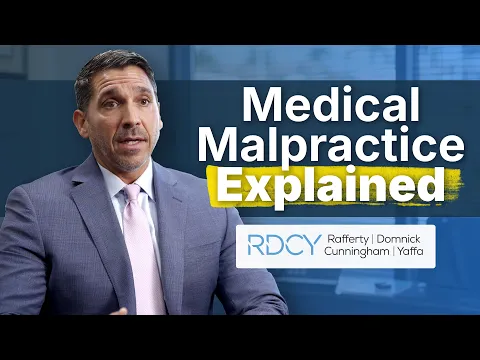
Florida Medical Malpractice Lawyer

When medical treatment leaves you or someone you love seriously injured, the first questions are rarely legal ones. What happened? Could the harm have been prevented? Who will pay for the additional care that is now needed? A Florida medical malpractice lawyer answers those questions in a particular order: first the medicine, then the evidence, then the law that Florida applies to both. Rafferty Domnick Cunningham & Yaffa (RDCY) represents patients and families across Florida in medical malpractice matters, and this page is the statewide hub for that practice — the place where the firm’s medical malpractice case types, its county pages, its investigation process, and the deadlines that govern every claim come together.
You do not have to identify every medical error before contacting a lawyer, and you do not need a complete file of records. Start with what you know: where the treatment occurred, what changed afterward, and why you are concerned. A careful evaluation can determine whether the care fell below the standard Florida law requires and whether further investigation is warranted. If you are ready to talk, call (561) 516-5168 for a free consultation.

Have Questions About Medical Malpractice?
Call us or request a case review by our experts.

What Counts as Medical Malpractice in Florida
Medical malpractice involves care that falls below the applicable professional standard and causes injury. Florida law measures that standard against the level of care, skill, and treatment that reasonably prudent similar healthcare providers would consider acceptable and appropriate under similar circumstances. A claim generally requires evidence of a provider’s duty to the patient, a departure from that standard, a connection between the departure and the injury, and resulting harm or losses.
A disappointing result, a known complication, or a worsening illness does not automatically establish negligence. Surgery carries risks even when it is performed correctly, and some conditions progress despite appropriate care. The investigation must examine what the provider knew at the time, what appropriate care required at that moment, and whether a failure caused harm beyond what the underlying condition would have caused anyway. That distinction — between a bad outcome and a preventable one — is where every Florida medical malpractice case begins.
Florida also treats medical malpractice differently from ordinary negligence from the very first step. Before a lawsuit can be filed, Chapter 766 of the Florida Statutes requires a presuit investigation corroborated by a qualified medical expert, followed by formal notice to each prospective defendant and a screening period. Those requirements, explained below, shape the timeline of every claim on this page and every sub-practice it organizes.
Medical Malpractice Cases We Investigate, Organized by Sub-Practice
Different medical errors require different records, different experts, and different litigation approaches. Rather than treating every concern as the same kind of case, RDCY organizes its medical malpractice practice into focused sub-practices, each with its own page explaining how those claims are evaluated. The categories below are the routes into that work.
Diagnosis Failures: Misdiagnosis, Delayed Diagnosis, and Failure to Diagnose
Diagnostic investigations examine whether symptoms, examination findings, imaging, laboratory results, or changes in a patient’s condition should have prompted a different or faster response. Our Florida misdiagnosis page addresses wrong and missed diagnoses generally, while the delayed diagnosis and failure to diagnose pages address timing — whether a diagnosis could reasonably have been made earlier, and whether the delay changed the patient’s treatment options or outcome. Inadequate testing and radiology errors are frequent contributors, and they have their own discussions under inadequate testing and radiology errors.
Cancer Malpractice
When the missed or delayed diagnosis involves cancer, the consequences of delay are measured in staging, treatment options, and survival chances. The firm’s dedicated Florida cancer malpractice page explains how screening failures, pathology and imaging misreads, and unacted-on results are investigated, including genetic testing misdiagnosis, which is addressed separately under genetic testing misdiagnosis.
Birth Injuries and Maternal Harm
Birth injury cases require close attention to prenatal care, labor and delivery records, fetal monitoring, clinical decisions during delivery, and the care given to mother and newborn afterward. An injury or diagnosis alone cannot establish its cause; the evaluation must separate the underlying medical condition from any additional harm caused by negligent care. The Florida birth injury page is the entry point for families asking these questions.
Stroke Misdiagnosis
Stroke is a time-critical emergency in which delayed recognition can permanently change the outcome. The Florida stroke misdiagnosis page addresses failures to recognize stroke symptoms in emergency and hospital settings and how experts evaluate whether earlier treatment could have changed the result.
Surgical, Anesthesia, and Medication Errors
A surgical investigation may examine the procedure performed, the operative record, anesthesia management, monitoring, and the response when complications developed. The fact that a patient needed another operation does not by itself explain whether the original care was negligent; understanding why the additional treatment became necessary is essential. See the firm’s pages on surgical errors, anesthesia errors, errors of commission, and errors of omission. Medication concerns — prescribing, dispensing, administration, or monitoring — are addressed under failure to provide medication, and failures to act on what care required are addressed under failure to perform a critical procedure.
Hospital Negligence and Emergency Room Errors
Hospital investigations can involve missed diagnoses, delayed treatment, inadequate monitoring, communication failures between teams, or a slow response to a deteriorating patient. The treatment timeline matters: who evaluated the patient, what information was available, which decisions were made, and what happened next. The firm’s pages on hospital negligence, emergency room errors, nursing errors, and distracted doctoring take up these failures in detail.
Medical Negligence and Medical Misconduct
Two related pages frame the broader categories. Florida medical negligence explains the underlying concept of care falling below the accepted standard, and Florida medical misconduct addresses conduct that goes beyond error. Both route back here, because the Chapter 766 process described next applies to the claim however it is characterized.
How Could Medical Malpractice Affect Your Legal Options?
Call us or request a case review by our experts.
How Florida’s Chapter 766 Presuit Process Works
Florida does not allow a medical malpractice claimant to file suit first and investigate later. Section 766.203 requires a reasonable presuit investigation, corroborated by a verified written opinion from a qualified medical expert, establishing reasonable grounds to believe that negligence occurred and caused injury. That expert review is not a formality: the expert must be qualified in the relevant field, and the opinion must support both the departure from the standard of care and the causal link to the harm.
Once the investigation is complete, §766.106 requires notice of intent to each prospective defendant. Delivery of that notice opens a 90-day presuit screening period during which suit generally cannot be filed. The prospective defendant investigates in turn, and the period can end in a rejection of the claim, a settlement offer, or an offer to arbitrate. Many cases resolve, narrow, or change shape during presuit, which is one reason the quality of the presuit investigation matters so much.
If the claim proceeds to litigation, the work expands: additional records and evidence, depositions of providers and witnesses, development of expert testimony for trial, and motions practice. RDCY prepares medical malpractice cases for the possibility of trial from the presuit stage onward, because settlement decisions are only meaningful when the other side understands the case can be tried. Settlement remains a decision for the client, made on a careful assessment of the evidence and the client’s circumstances.
Florida Medical Malpractice Deadlines
Florida generally requires a medical malpractice action to be brought within two years of when the incident occurred or when it was discovered, or should have been discovered through due diligence. A separate four-year statute of repose generally bars claims filed more than four years after the incident itself, regardless of discovery. The statute contains exceptions, including provisions involving certain claims brought for young children and circumstances involving fraud, concealment, or intentional misrepresentation, and presuit procedures can affect how time is calculated.
These rules must be applied to the actual facts — the treatment dates, when the injury was or could have been discovered, and which exception, if any, is in play. Do not use the treatment date alone, or the date of a later diagnosis alone, to decide whether you still have time. Because presuit investigation and expert corroboration must happen before notice and suit, the practical deadline for contacting a lawyer is well inside the legal one.
What to Do if You Suspect Medical Malpractice
Put your health first. Obtain appropriate medical care for ongoing or worsening symptoms, and never let a legal investigation delay treatment. If symptoms suggest an emergency — the sudden weakness, speech difficulty, vision changes, or trouble walking that can signal stroke, for example — seek emergency care immediately rather than calling a law firm.
While treatment continues, preserve information. Write a timeline of appointments, symptoms, treatment, and subsequent events. Save discharge instructions, medication information, bills, and correspondence; keep copies of portal messages and the records already available to you; record the names of the providers and facilities involved; and preserve original documents rather than editing them. You do not need a perfectly organized file before seeking legal help — bring what you have and identify what is missing.
Request the relevant medical records, and understand what a complete set looks like. Patients generally have access under HIPAA to a broad range of information in designated record sets, including medical records, laboratory reports, imaging, and billing information, subject to exceptions. Ask for imaging reports and the images themselves; a patient-portal summary may omit material the evaluation needs. Finally, seek a legal evaluation promptly: requesting records, complaining to a hospital, or filing a licensing complaint does not protect a lawsuit deadline, and an attorney should assess the applicable time limits while the investigation is getting underway.
How RDCY Investigates a Medical Malpractice Claim
The investigation begins with the treatment history and the available records. Counsel evaluates the potential defendants, the medical questions the records raise, the injury, and the evidence needed to proceed — including which qualified experts must review the care and what they will need to see. Where records are incomplete, the gaps are identified rather than filled in from memory, and further collection is planned as part of the evaluation.
Research can inform that work but never replaces it. Published studies of diagnostic error, for example, help explain recurring patient-safety problems; they do not establish that a particular Florida doctor or hospital committed malpractice. For an individual claim, the medical records and qualified expert analysis of the actual care remain central, and the firm’s published analysis of how Florida malpractice evidence is built reflects that discipline.
Not every evaluation becomes a case. Where the evidence does not support a claim, the family hears that directly, with the reasoning. Where it does, presuit is built to be taken seriously by the providers and insurers who receive it — and to be ready for litigation if they do not respond appropriately.
Compensation and the Long-Term Impact of a Medical Injury
A serious medical injury affects far more than the hospital bill. Evaluating losses may require evidence concerning past and future medical treatment, rehabilitation and personal care, lost earnings and reduced earning ability, physical impairment and disability, and pain, suffering, mental anguish, and loss of enjoyment of life. Available damages depend on the claim and the supporting evidence, and future losses require careful assessment — often with treating providers and qualified experts — rather than assumptions about what care will cost.
Questions about caps come up in almost every consultation, and blanket statements are usually wrong. In North Broward Hospital District v. Kalitan, the Florida Supreme Court held the personal-injury malpractice caps in §§766.118(2) and (3) unconstitutional, so it is inaccurate to say Florida caps all medical malpractice noneconomic damages. Other limitations can apply in particular circumstances: claims involving government entities, for example, require separate analysis under Florida’s sovereign immunity framework. The correct answer always depends on who the defendant is and what kind of claim is brought.
There is likewise no standard settlement amount for medical malpractice. A verdict or settlement reported in another case does not value yours; the evidence, the losses, and the ability to prove liability and causation do that work, case by case.
Why Florida Patients Choose RDCY for Medical Malpractice
Choosing counsel for a malpractice claim means looking beyond general claims of experience. These cases require lawyers who can investigate complicated care, work with qualified experts, and present technical evidence clearly to a jury. RDCY’s medical malpractice work is led by trial lawyers whose credentials can be checked independently, starting with shareholder Sean C. Domnick.
Sean is a Florida Bar Board-Certified Civil Trial Lawyer — a credential requiring qualifying experience, substantial involvement in the field, continuing education, peer review, and an examination. He served as the 78th president of the American Association for Justice in 2023–2024 and was elected president of the Palm Beach County Justice Association in 2018. Best Lawyers has recognized him since 2005, with Medical Malpractice Law – Plaintiffs among his listed practice areas, and Super Lawyers records his selections from 2006 through 2026, including medical malpractice among his practices.
The firm’s published work reflects the same focus: Sean has authored legal commentary on hospital accountability, including a November 2025 Bloomberg Law article addressing a Florida hospital appellate decision, and the firm’s professional record includes teaching on expert witnesses, hospital liability, stroke litigation, and presuit investigation. In its published account of the Ava D’Andrea litigation, the firm describes work by Sean Domnick and Nicole Kruegel involving a permanent spinal cord injury following scoliosis surgery, disputed discovery, and sanctions, ending in a confidential settlement after trial began; defense counsel disputed the court’s characterization of the discovery conduct. That account illustrates the evidence fights hospital litigation can involve. It does not predict any other client’s outcome.
One boundary deserves emphasis, because families often blur it: reporting unsafe care and suing for malpractice are different processes. The Florida Department of Health investigates complaints against regulated practitioners and can discipline them, but it does not represent patients in civil claims for compensation, and an administrative complaint does not itself establish civil liability or stop a filing deadline from running. RDCY can explain how the two tracks interact — the authority materials below collect the firm’s recognition, publications, results, and reviews in one place so they can be weighed directly.
Medical Malpractice Help by County and Across Florida
This page is the statewide root; the firm’s county hubs carry the local layer. The Palm Beach County medical malpractice hub covers the county where the firm’s main office sits, and the Broward County medical malpractice hub covers Broward’s hospital systems and the 17th Judicial Circuit. City pages beneath each hub address the facilities and courts closest to home, while the framework on this page — presuit, deadlines, damages — applies statewide.
RDCY also maintains medical malpractice pages for patients treated elsewhere in Florida, including Jacksonville, Miami, Orlando, Tampa, and Pensacola. Wherever the care occurred, the first step is the same: a review of the treatment and the records, against the deadlines Chapter 766 and §95.11 impose.
Related Medical Malpractice Pages
The statewide practice, organized: the two county hubs for South Florida, and the firm’s focused sub-practice pages for the case types described above.
- Broward County
- Palm Beach County
- Florida Cancer Malpractice Lawyer
- Florida Birth Injury Lawyer
- Florida Stroke Misdiagnosis Lawyer
- Florida Misdiagnosis Lawyer
- Florida Medical Negligence Lawyers
- Florida Medical Misconduct Lawyers
Professional Recognition


Recognition applies to the named attorneys and selection years. See the linked profiles for details.
GOOGLE REVIEWS
General feedback from individual five-star Google reviews:
“He is true lawyer for the people displaying great enthusiasm, professionalism and compassion.”
— Jeff
“Can not say thank you enough!”
— PJ
Florida Medical Malpractice FAQs
The answers below are general information about Florida medical malpractice law. The medical evidence, treatment dates, provider relationships, and applicable law must be evaluated for each individual matter before they can be applied to a specific claim.
Can I have a Florida medical malpractice case if the doctor says the injury was a known complication?
Possibly. Identifying a known risk does not resolve every question about the care provided. The evaluation considers whether the procedure and the treatment that followed met the applicable standard of care, and whether a departure from that standard caused injury beyond the complication itself.
Consent and negligence are separate issues. Bring the consent documents and any explanation you received about the complication to the consultation, so a lawyer can identify the medical questions that require expert assessment — without assuming that either the complication or the consent form settles the claim.
Sources: Florida Statutes Chapter 766, Medical Malpractice and Related Matters; AHCA Florida HealthFinder, Facility Search.
What does Florida’s Chapter 766 presuit process require before a malpractice lawsuit can be filed?
Before suit, a claimant must complete a reasonable presuit investigation corroborated by a verified written opinion from a qualified medical expert, giving reasonable grounds to believe negligence occurred and caused injury. The claimant must then serve a notice of intent on each prospective defendant.
Service of the notice opens a 90-day presuit screening period during which suit generally cannot be filed, and the prospective defendant investigates and responds — by rejecting the claim, offering settlement, or offering arbitration. Because presuit comes first, the investigation should begin well before any limitations deadline approaches.
Sources: Florida Statutes Chapter 766, Medical Malpractice and Related Matters; Florida Statutes §95.11, Limitations Other Than for the Recovery of Real Property.
How long do I have to file a medical malpractice claim in Florida?
Generally two years from the incident, or from when the injury was discovered or should have been discovered with due diligence. A four-year statute of repose generally bars claims filed more than four years after the incident, subject to exceptions that include certain claims for young children and cases involving fraud, concealment, or intentional misrepresentation.
Presuit procedures affect how the time is calculated, so do not rely on the treatment date — or a recent diagnosis — alone. Bring the treatment dates and the date you first learned of the possible problem to a lawyer promptly, because the expert review and notice steps must be completed inside the available window.
Sources: Florida Statutes §95.11, Limitations Other Than for the Recovery of Real Property; Florida Statutes Chapter 766, Medical Malpractice and Related Matters.
What if I do not know which Florida provider made the mistake?
You can seek an evaluation before identifying every potentially responsible provider. Start with the facility, the treatment dates, the symptoms, and the harm you experienced; those details define the scope of the investigation.
Avoid guessing which individual is responsible based only on a name appearing in the chart. Florida’s presuit process requires investigation of the treatment sequence and each provider’s role together before decisions are made about potential defendants, and naming the wrong provider — or omitting the right one — can create real problems later.
Sources: Florida Statutes Chapter 766, Medical Malpractice and Related Matters; AHCA Florida HealthFinder, Facility Search.
Do I need all my medical records before contacting a Florida medical malpractice lawyer?
No. You can contact a lawyer with the information and records already available to you. Identify the providers, the approximate dates, and the reason for your concern, and explain which records you have already requested.
Patients generally have access rights to their records under HIPAA, and Florida law separately addresses records relevant to medical negligence claims. Preserve what you receive and keep a record of your requests; if something appears missing, describe the gap rather than filling it in from memory, and further collection can be planned as part of the evaluation.
Sources: Florida Statutes Chapter 766, Medical Malpractice and Related Matters; AHCA Florida HealthFinder, Hospital Guide.
Does a later diagnosis prove that the first diagnosis was negligent?
No. A later diagnosis is a reason to examine the earlier care, not proof of negligence by itself. The review considers the symptoms, findings, and opportunities for diagnosis that were available at the earlier visit, judged by what a reasonably prudent similar provider would have done then.
For your evaluation, explain what changed between visits and provide the available records from both encounters. A qualified expert can then assess whether the earlier information called for a different response and whether the delay caused harm — the two questions a diagnostic claim actually turns on.
Sources: Florida Statutes Chapter 766, Medical Malpractice and Related Matters; CMS Provider Data.
Can my family pursue a claim if medical negligence caused a death in Florida?
Potentially, yes. Florida’s wrongful death rules determine who may recover and which damages are available; a personal representative brings the action on behalf of qualifying survivors and the estate.
Medical negligence deaths carry specific restrictions on some survivors’ damages, and family relationship and age can matter, so do not assume every relative has the same rights. Identify the deceased person’s spouse, children, parents, and estate representative during the evaluation, and have counsel assess negligence, causation, survivor eligibility, and deadlines together.
Sources: Florida Statutes Chapter 768, Negligence; Florida Statutes Chapter 766, Medical Malpractice and Related Matters.
Are medical malpractice damages capped in Florida?
Not across the board. In North Broward Hospital District v. Kalitan, the Florida Supreme Court held the personal-injury malpractice caps in §§766.118(2) and (3) unconstitutional, so the statement that Florida caps all medical malpractice noneconomic damages is inaccurate.
Other limitations can still apply in particular circumstances — claims against government entities, for example, require separate analysis under the sovereign immunity framework in Chapter 768. Ask counsel to identify which rules govern your defendant and your claim rather than relying on a general statement about caps.
Sources: Florida Statutes Chapter 766, Medical Malpractice and Related Matters; Florida Statutes Chapter 768, Negligence.
Does reporting a doctor to the Florida Department of Health preserve my right to sue?
No, and you should not rely on a licensing complaint to protect a civil deadline. The Department of Health’s complaint process concerns professional regulation and discipline; a malpractice lawsuit is a separate civil claim for compensation, and the department does not represent patients in civil matters.
If you are considering both routes, get separate guidance on the lawsuit deadline rather than waiting for the complaint investigation to finish. Preserve the complaint and any response, but understand that an administrative outcome does not automatically decide the medical negligence claim either way.
Sources: Florida Department of Health, Licensing and Regulation; Florida Statutes §95.11, Limitations Other Than for the Recovery of Real Property.
How much does it cost to have RDCY review a Florida medical malpractice claim?
The initial consultation is free: you can describe the treatment and the harm, and the firm can explain whether further investigation is warranted, without paying for that first review. Any later representation, and how fees and case costs would be handled, should be explained and put in writing before you agree to it.
Use the consultation to ask how the Chapter 766 presuit investigation would be staffed, how medical experts are selected, and how you would receive updates. The Florida Bar’s public resources explain what clients should expect when hiring a lawyer, and a clear written fee explanation is part of that standard.
Sources: Florida Statutes Chapter 766, Medical Malpractice and Related Matters; The Florida Bar, Information for the Public.
Related Articles
- How Florida’s Medical Malpractice Pre-Suit Investigation Works
- How Missed or Delayed Diagnoses Happen—and Why Differential Diagnosis Protocols Matter
- Why Contacting Counsel Before Record Requests Can Save Time And Reduce Cost
- How To Document Damages: Treatment Courses, ADLs, And Pain Journals
- Suing for Medical Malpractice After Emergency Room Negligence
- When Seconds Count: The Devastating Consequences of Stroke Misdiagnosis
Need Help With a Case Involving Medical Malpractice?
Call us or request a case review by our experts.