Tampa FL Medical Malpractice Lawyer
Unexpected harm during medical care can leave you trying to understand what happened while managing treatment, bills and family responsibilities. You do not need to decide that a doctor or hospital was negligent before seeking an explanation.
Rafferty Domnick Cunningham & Yaffa helps patients and families in Tampa FL evaluate serious medical-negligence concerns. The starting point is the care, the records and whether preventable failures caused additional harm. The firm’s statewide practice includes medical malpractice, hospital negligence, birth injury and catastrophic injury matters.
If someone may be experiencing a medical emergency, seek emergency care immediately. A legal inquiry is a separate step and should not delay treatment.
Find the Information You Need
- What to do now
- Local treatment and records
- Florida claim requirements
- Firm experience and published work
- Medical malpractice FAQs
What to Do Now After Suspected Medical Negligence
Continue discussing your current health needs with qualified treating professionals. Ask what the diagnosis means, what follow-up is needed and whom to contact if symptoms change. AHRQ’s questions about a diagnosis can help prepare for that conversation.
- Write a short timeline: symptoms, visits, tests, treatment decisions and changes in condition.
- Preserve original discharge instructions, imaging reports, medication lists and patient messages.
- List every treating facility and physician, including later care that explains the injury.
- Keep bills, insurance communications and work or caregiving records.
- Identify who can authorize access if you are helping another patient.
- Address legal deadlines promptly; records gathering or a complaint does not automatically stop the clock.
Your notes should distinguish what you observed from what you were told. You do not have to solve the medical issues or hire an expert yourself before contacting the firm. Records-access guidance; Florida presuit investigation requirements.
Rafferty Domnick Cunningham & Yaffa
Medical malpractice legal help
Medical Malpractice in Tampa: Complex Operations, Anesthesia and Recovery
For an operation involving several clinicians, a review may need to distinguish the surgeon’s decisions, anesthesia management and postoperative monitoring. An injury recognized during recovery might relate to any of these stages, or to an unavoidable risk. The record should guide which disciplines require expert assessment.
Identify the procedure and date, the first new symptom and every later admission. Request operative and anesthesia records through the appropriate custodian, together with recovery-room notes and later testing where available. Preserve the original discharge instructions even if another clinician subsequently changes the treatment plan. A change in treatment is relevant information; it is not itself an admission of negligence.
The applicable legal question is whether care fell below the professional standard and caused injury. Florida Statutes § 766.102.
Tampa Medical Records and Patient Resources
- Tampa General Hospital medical-record instructions. Use this route only for treatment within the named provider or network. Select the actual facility and dates of care; separate physician, imaging or transport records may require additional requests.
- HHS guidance on access to medical and billing records. Explains patient access and representative considerations, subject to the applicable rules and exceptions.
- Florida Department of Health complaint forms. Provides practitioner-complaint information. Facility concerns may belong with a different agency; use the state’s complaint-routing guidance.
These providers are listed as records resources, not as allegations of negligence or recommendations about where to receive treatment. For care outside the named network, request information from the actual records custodian. Medical records are not obtained from the county court clerk.
Treatment in Hillsborough County does not alone settle the proper court, all responsible parties or the governing claim procedure. Florida’s venue statute addresses legally relevant connections. Tell counsel if treatment crossed state lines or involved a government provider.
What Florida Requires for a Medical Malpractice Claim
A claim needs more than evidence of a disappointing result. The investigation considers the professional standard under the circumstances, a departure from that standard and injury caused by the departure. A preventable error with no resulting injury and a serious injury without negligent care raise different legal questions. Medical-negligence standard and expert qualifications.
Florida generally requires reasonable presuit investigation and a supporting verified medical-expert opinion meeting the statute’s requirements. Presuit notice and a screening period usually precede filing. These steps are substantive parts of the process, not paperwork that should be left until the limitations period is about to expire. Presuit investigation; notice and screening.
Certain qualifying birth-related neurological injuries may fall within a specialized compensation program rather than the usual malpractice route. Florida Statutes § 766.303.
The limitations statute generally provides two years measured from the incident or discovery, including when discovery should have occurred with due diligence, and a four-year outer limit with statutory exceptions. Children, concealment, particular defendants and statutory compensation routes can affect the analysis. Do not treat a hospital complaint, insurance negotiation or ongoing care as protection against a deadline. Florida limitations statute.
Concerns the Investigation May Address
- Diagnosis: whether reported symptoms, test findings or referrals required further action.
- Surgery and anesthesia: the procedure, monitoring and response to complications.
- Medication: the order, administration, known risks and follow-up.
- Hospital care: deterioration, communication between teams and discharge planning.
- Birth injury: prenatal, delivery and newborn care, including any applicable statutory compensation issues.
A hospital, practice and individual clinician may have different responsibilities. Employment, agency and the actual events must be examined; the person whose name appears on a bill is not necessarily the only relevant party. Expert review must address the specific disciplines involved. Florida medical-negligence law.
Evidence of the Harm and Its Effect on Daily Life
Records of later care can help explain the diagnosis, additional procedures, rehabilitation and future needs. Keep documentation of expenses, time away from work and help required at home. A working diary can describe practical limitations, but it does not replace medical evidence or justify an assumed case value.
Compensation depends on the proven injury, legally available categories and applicable rules. A death requires a separate review of who may recover and Florida’s medical-negligence-specific wrongful-death restrictions. Comparative-fault rules also distinguish medical-negligence claims from the general greater-than-50-percent bar. Civil damages instructions; wrongful-death damages; comparative fault.
Reliable Medical Information Without Guessing About Your Case
Government health guidance can help you understand what to ask about present care. CDC stroke guidance and CDC sepsis guidance explain urgent warning signs and the need for emergency evaluation. They cannot establish why an individual injury occurred.
Peer-reviewed research helps explain safety questions that investigators examine. A 2014 BMJ Quality & Safety study examined outpatient diagnostic errors using three observational datasets. A 2014 New England Journal of Medicine handoff study evaluated changes following a structured handoff program in pediatric settings. Their populations, methods and settings matter: neither provides a Tampa malpractice rate or proves negligence by a local clinician.
Use these materials to prepare questions, not to diagnose yourself or select treatment. The legal assessment requires individual records and suitable medical expertise.
Rafferty Domnick Cunningham & Yaffa
Medical malpractice legal help
RDCY’s Medical Malpractice Experience and Professional Authority
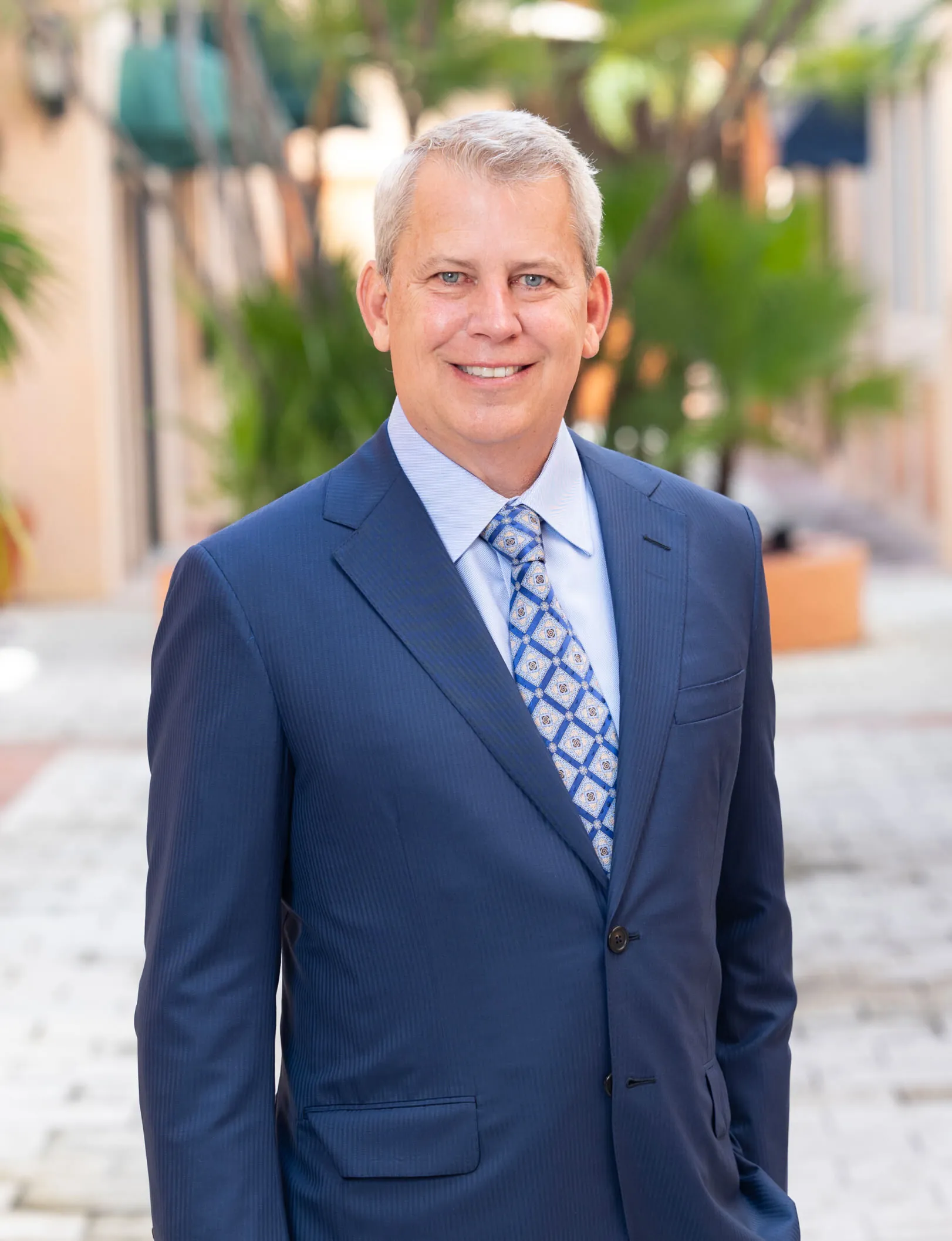
Choosing counsel means asking how the firm will investigate the medicine, develop evidence and prepare a case. RDCY’s medical-malpractice practice includes serious diagnostic, hospital, surgical and birth-injury matters. Sean C. Domnick’s professional biography identifies these areas of practice and his Florida Bar board certification in civil trial law.
That is a civil-trial credential. It should be considered alongside the lawyer’s relevant practice and the proposed approach to your case. Ask who will be responsible for the matter, which expert disciplines may be needed and what evidence could change the initial assessment.
Elected Leadership and Trial-Lawyer Service
- American Association for Justice president, 2023–2024. AAJ’s own leadership record identifies Domnick as its 78th president and describes his medical-malpractice and catastrophic-injury practice.
- Palm Beach County Justice Association president, 2018. The election announcement documents local professional leadership.
- Additional professional service. His firm biography describes past Miami-Dade trial-lawyer association leadership, Florida Justice Association board service, and connections with the International Academy of Trial Lawyers, International Society of Barristers and American Board of Trial Advocates. The biography lists Miami-Dade Justice Association president in 1999, FJA board service beginning in 1996, IATL induction in 2017 and board service in 2022, and selection as an International Society of Barristers fellow in 2019.
These records give readers specific professional experience to evaluate. Association membership or an elected role cannot predict the result of an individual claim.
His biography lists service on The Florida Bar’s Civil Procedure Rules Committee for 2023–2027. It also records trial-advocacy teaching, including “The Epidemic of Missed Strokes” for the Western Trial Lawyers Association in 2024 and “Advocacy Track: Everything to Know on Experts” at AAJ’s 2025 Winter Convention. These are legal education engagements relevant to evaluating medical evidence and trial preparation. Professional service and teaching record.
Original Legal Publications and Google Scholar Discovery
- A Collective Effort, Trial, December 2023.
- Treating Workers Fairly, Trial, January 2024.
- Tossing Damages in Florida Hospital Case Shakes Faith in Justice, Bloomberg Law, November 2025.
- Why Stroke Misdiagnosis Is a Medical-Malpractice Crisis, Orlando Sentinel, June 2025.
- AAJ’s complete index of Domnick’s presidential columns.
- Google Scholar author-name lookup for S. C. Domnick.
The original publishers provide the clearest authorship and publication context. The Scholar link is a bibliographic discovery aid, not a claim that Domnick authored peer-reviewed medical research or a substitute for the medical sources above. His legal writing gives readers an opportunity to examine his approach to civil justice and hospital litigation directly.
The independent Best Lawyers profile identifies recognition since 2005 and lists Medical Malpractice Law – Plaintiffs among his recognized practices. His firm biography documents AAJ’s Joe Tonahill Award in 2023 and FJA’s W. McKinley Smiley Jr. Award in 2018 for mentorship, alongside other professional recognition. Recognition is attributed to the named lawyer and does not guarantee an outcome.
Medical Malpractice Help Across Florida
- Medical Malpractice Overview
- West Palm Beach
- Jacksonville
- Pensacola
- Boca Raton
- Delray Beach
- Boynton Beach
- Jupiter
- Wellington
- Orlando
- Tampa
- Miami
- Fort Lauderdale
Firm Office Information
Palm Beach Gardens office: 4560 Donald Ross Road, Palm Beach Gardens, FL 33418. This is the firm’s Palm Beach Gardens office, serving as a contact point for its statewide practice.
Rafferty Domnick Cunningham & Yaffa
Medical malpractice legal help
Talk With RDCY About Tampa Medical Care
Call (561) 516-5168 for a free consultation. Explain the treatment dates, the concern and how the patient’s condition changed. Bring what you already have and identify missing records during the discussion. Firm contact information.
RDCY serves people throughout Florida. This page addresses medical malpractice concerns in Tampa; consult the firm’s contact page for its actual office locations and confirm meeting arrangements.
If you are helping another adult, explain your relationship and any authorization to access records. Contact does not itself establish representation; acceptance of a matter depends on the firm’s assessment.
Medical Malpractice Video Library
The Most Common Medical Malpractice Claims Explained | Rafferty Domnick Cunningham Yaffa
The Most Common Medical Malpractice Claims Explained | Rafferty Domnick Cunningham Yaffa
Video Transcript
The most common types of medical malpractice cases that we see here at RDCY really fall into two main categories. We see a lot of birth injury traumas where you have lifelong injuries caused to newborns during the delivery process. Either too much force is used or the baby is allowed to be in the birth canal for too long and the baby goes into distress and because of the oxygen deprivation because of the lack of oxygen to the brain. The babies then suffer lifelong injuries. We also see a lot of stroke cases where when you have a stroke and there are two different types of main strokes that we see. We see ischemic strokes which are strokes where there’s a blockage in the brain and then we see hemorrhagic strokes where there’s a bleed and often when somebody shows up at the hospital. There’s a specific window of time within which uh TPA can be given. It’s a clot busting drug. We see a lot of stroke cases where people appear at the hospital within the appropriate window to receive that clot busting drug and they don’t receive it and as a result they don’t end up making the same recovery that they otherwise would have made.
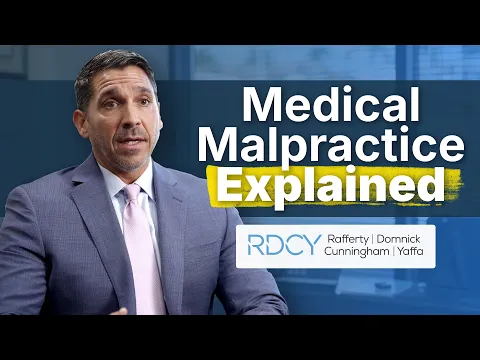
What Counts as Medical Malpractice? | Rafferty Domnick Cunningham Yaffa
What Counts as Medical Malpractice? | Rafferty Domnick Cunningham Yaffa
Video Transcript
We get calls all the time about whether or not I have a medical malpractice claim or not. Unfortunately, sometimes, even with the most appropriate medical care, there are bad outcomes. And just having a bad outcome does not mean automatically that you have a valid medical malpractice claim. In Florida, there are very strict requirements that we have to abide by before we can ever even pursue a medical malpractice claim.
First and foremost, we have to have an expert on board and we have to have an expert write an affidavit basically saying that the target defendant, the doctor or the nurse that we’re going after fell beneath the appropriate standard of care. Uh because again because you can have a bad outcome even with appropriate care. You need to have an expert in place that can say I’ve reviewed the medical records and this doctor or this nurse did not comply with the applicable standard of care and as a result you have a valid reason to move forward and pursue a medical malpractice case. It’s not like an auto accident or any other type of general negligence case where you can just file a lawsuit the day after a crash. You actually have to comply with Florida statute and presuit notice requirements before you could ever pursue a medical malpractice claim.
Tampa FL Medical Malpractice FAQs
These answers provide general information. The applicable law, medicine and deadlines require assessment of the individual facts.
Does a bad medical outcome automatically mean malpractice?
No. A difficult recovery or unexpected complication does not by itself establish medical negligence. Florida law requires proof that the applicable professional standard was breached and that the breach caused injury. The assessment must examine the circumstances of the treatment, not simply compare the result with what the patient hoped would happen.
Describe the specific concern: a test result that was not explained, a medication discrepancy, a change after surgery, or a problem during discharge. Keep the relevant dates and documents. A medical review can distinguish an underlying illness, an unavoidable complication and potentially preventable additional harm. Population research and online symptom comparisons cannot resolve that distinction for an individual patient.
Sources: Florida Statutes § 766.102: medical negligence and expert testimony; AHRQ: preparing questions and discussing a diagnosis.
What is the deadline for a Florida medical malpractice claim?
Florida generally has a two-year medical-malpractice limitations period measured from the incident or its discovery, including when it should have been discovered with due diligence. The statute also contains a four-year outer limit, with exceptions including specified circumstances involving children and concealment. These rules must be applied together; simply adding two years to the treatment date may be wrong.
Presuit notice, screening and statutory tolling can affect the calculation. Other requirements may apply to particular defendants or claims. Give counsel the treatment date, when you first suspected an injury, later diagnostic findings and any correspondence. Do not wait for every record, a hospital complaint response or an insurer’s decision before addressing time limits. A consultation should identify the dates requiring investigation.
Sources: Florida Statutes § 95.11: limitations periods; Florida Statutes § 766.106: presuit notice and screening.
Can I request medical records before deciding whether to sue?
Yes. A patient can generally request access to covered medical and billing records without first filing a lawsuit. A representative may need authorization or proof of legal authority. The applicable rules and exceptions depend on the records and their custodian; Florida’s practitioner-record statute does not apply to every kind of facility.
List the treating locations, providers and dates so requests reach the correct offices. Keep your request, the response and the files in their original form. Specify imaging or other material that a brief portal summary may not include. Gathering records is useful for continuing care as well as legal review, and it does not require you to conclude that anyone acted negligently.
Sources: HHS: the right to access medical and billing records; Florida Statutes § 456.057: practitioner records and confidentiality.
Will reporting a doctor or hospital obtain compensation for me?
A regulatory complaint and a claim for compensation serve different purposes. Florida’s complaint process helps direct a concern to the agency with the appropriate responsibility. It does not automatically establish civil liability, determine the value of an injury or replace the steps required for a malpractice claim.
Provide an accurate chronology, the provider or facility name and the documents supporting your concern. Keep copies of what you submit. Complaints about licensed practitioners and complaints about facilities may go to different agencies. If you also want a legal assessment of compensation, address that separately and identify the applicable deadlines. Do not wait for an agency investigation to finish before asking how those deadlines affect your options.
Sources: Florida Department of Health: health care complaint forms; Florida Department of Health: where to direct complaints.
Do I need an expert opinion before filing a malpractice lawsuit?
Florida’s malpractice process generally requires presuit investigation and medical support meeting the applicable legal requirements. A patient’s concern starts the inquiry, but it is not a substitute for that investigation. Expert qualifications and the supporting opinion must fit the issues being evaluated.
You do not have to commission an expert yourself before speaking with RDCY. Bring the information you already have and explain the treatment concern. Counsel can evaluate which records and medical disciplines are relevant and whether further review is justified. The purpose is to assess both the care and its connection to the injury; obtaining a critical opinion about one part of treatment does not automatically prove the entire case.
Sources: Florida Statutes § 766.203: presuit investigation; Florida Statutes § 766.102: medical negligence and expert testimony.
What losses can a medical malpractice claim address?
A supported claim may address losses caused by medical negligence, including additional medical expenses, lost income and other compensable harm. The available categories depend on the evidence and applicable law. A hospital charge or diagnosis alone does not establish the value of a case; the assessment must distinguish the underlying condition from additional injury caused by the alleged negligence.
Keep bills, insurance explanations, work records and documentation of assistance needed at home. Future losses generally require suitable evidence rather than estimates drawn from other settlements. If the patient died, Florida’s wrongful-death rules identify who may recover particular damages and contain medical-negligence-specific restrictions. The family relationships and circumstances must be reviewed rather than assuming every relative has the same claim.
Sources: Florida standard civil jury instructions: damages; Florida Statutes § 768.21: wrongful-death damages.
Can anesthesia care be reviewed separately from the operation?
Yes. Anesthesia and surgery involve related but potentially different responsibilities. The assessment may require the anesthesia record, monitoring information and clinical findings before and after the procedure. The medical issues determine which qualified experts are needed, rather than assuming one opinion covers every part of care.
Bring the documents relevant to this concern, including earlier and later care. Identify the dates, clinicians and instructions rather than relying on a short portal summary. Counsel can assess which records and expert disciplines are needed. The purpose of review is to connect any departure from appropriate care to the harm; disagreement, a complication or an incomplete explanation alone does not establish every element of a claim.
Sources: Florida Statutes § 766.102: medical negligence and expert testimony; HHS: the right to access medical and billing records.
Does signing a surgical consent form prevent a malpractice claim?
Not automatically. Florida’s medical-consent law addresses consent under its stated requirements; a signed form does not by itself resolve whether treatment was negligent. The investigation should distinguish the discussion of risks and alternatives from the actual performance and monitoring of care.
Keep a chronology with original reports and communications alongside your notes. Ask the treating team about present care needs, and address the legal assessment separately. The source information supplies context, but your situation requires its own factual review. Tell counsel about uncertainty in dates, different treating locations or missing material so the investigation can address those gaps without guessing.
Sources: Florida Statutes § 766.102: medical negligence and expert testimony; Florida Statutes § 766.103: medical consent.
Where can I request records for treatment in Tampa?
Request them from the actual treating provider or records custodian. Tampa General Hospital publishes instructions for care within its system. That route does not cover every provider in Tampa, and a portal download may not include all records needed for review. Identify the facility, treating dates and requested documents.
Ask whether imaging, physician-office records, transport documents or other material require separate requests. A representative may need authorization or proof of legal authority. Keep copies of requests and responses, preserve the original files and avoid editing a disputed entry. If a correction is needed for current care, use the custodian’s formal amendment process while retaining the original material.
Sources: Tampa General Hospital: medical-record requests; HHS: the right to access medical and billing records.
How do I contact RDCY about a Tampa malpractice concern?
Call (561) 516-5168 or use the firm’s contact page to request a free consultation. Describe the treatment, the injury and any urgent legal correspondence. You can begin with the information available now rather than waiting for a complete file or commissioning an expert on your own.
Prepare a short timeline and a provider list, and note what changed in daily life or later treatment. If you are asking for another person, identify your relationship and records-access authority. Confirm meeting arrangements and ask who would handle the assessment. Initial contact does not by itself create an attorney-client relationship, guarantee acceptance or resolve the legal merits.
Sources: RDCY: consultation and office contact information; HHS: the right to access medical and billing records.