
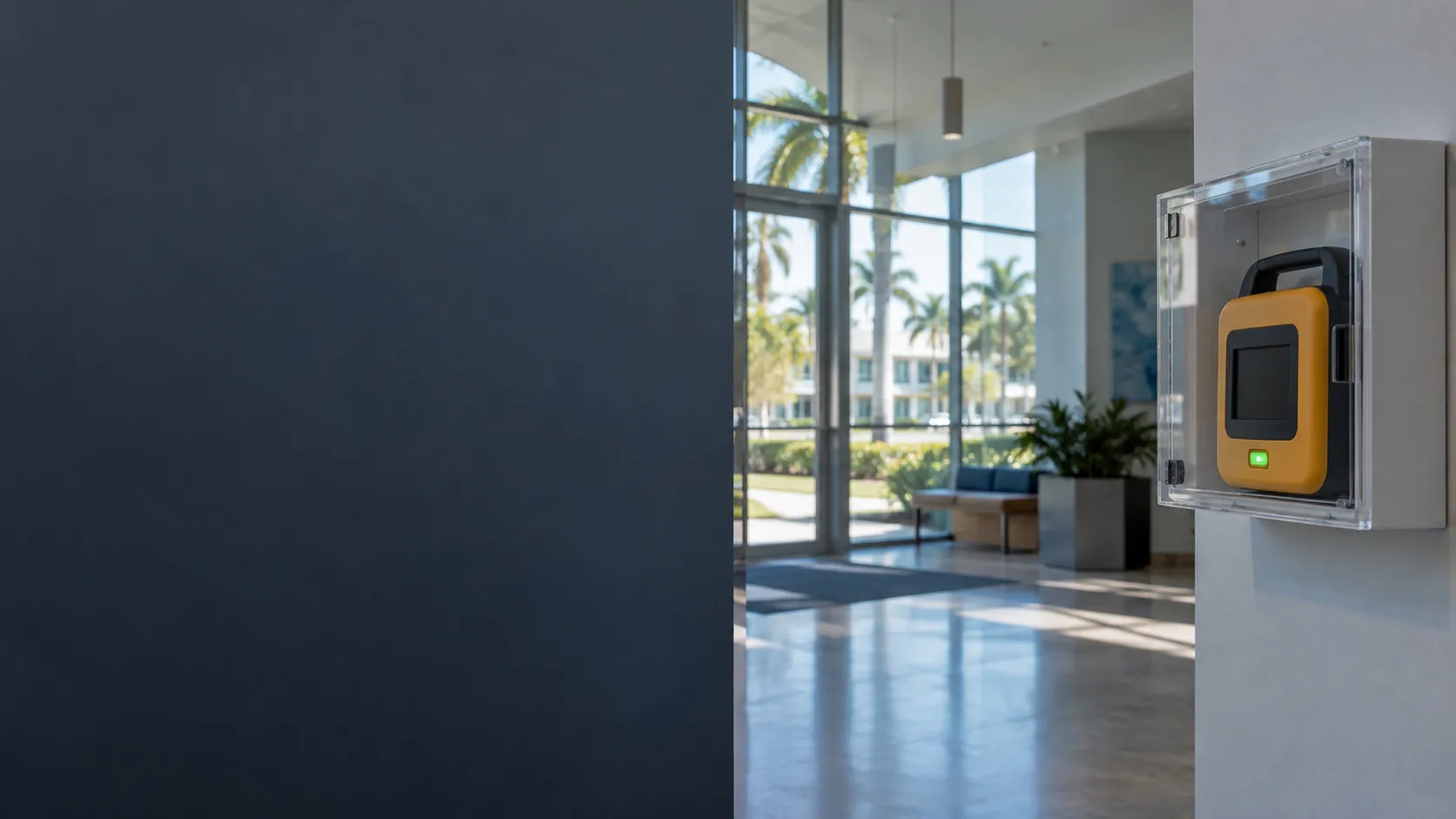
Heart Attacks in Public Places
A cardiac emergency at a school, gym, hotel, airport, or other public place can leave a family with urgent questions about what happened before help arrived. Was 911 called promptly? Was an automated external defibrillator (AED) available and working? Did a preventable delay or equipment problem contribute to a death or serious injury?
Rafferty Domnick Cunningham & Yaffa reviews potential claims involving public-place cardiac emergencies, AED problems, and emergency response. A review starts with the medical event and the response timeline, then examines the responsibilities of the people and organizations involved. The fact that an emergency happened on someone else’s property does not, by itself, establish a claim.
If a cardiac emergency is happening now, call 911. Follow the dispatcher’s instructions and the AED’s prompts when using the device.
Sources: NIH: Cardiac Arrest Treatment
Have Questions About Heart Attacks in Public Places?
Call us or request a case review by our experts.
Heart Attacks and Sudden Cardiac Arrest Are Different
A heart attack occurs when blood flow to part of the heart is blocked. Cardiac arrest occurs when the heart suddenly stops pumping blood effectively. A heart attack can lead to cardiac arrest, but the terms describe different medical events.
That distinction matters when investigating an AED claim. An AED checks the heart’s rhythm and can deliver a shock when appropriate. It is not a treatment for every heart attack, and not every cardiac arrest has a rhythm that an AED can treat. The medical records and device data help establish what was happening at the time.
Sources: NIH: What Is a Heart Attack? · NIH: What Is Cardiac Arrest? · NIH: How Do Defibrillators Work?
What May Need to Be Investigated
An investigation separates a possible device problem from problems with access, maintenance, or the emergency response. More than one issue may require review, and each needs evidence.
- Availability: whether an AED was present at the location as required by state law
- Equipment: whether the AED, battery, pads, or other components performed as intended; whether the specific device was affected by a recall or safety alert.
- Readiness: the condition of the battery and pads, inspection records, service history, and the manufacturer’s instructions.
- Access: where the AED was located, whether responders could retrieve it, and whether a cabinet, locked room, or missing key delayed access.
- Response: when staff recognized the emergency, called 911, began assistance, retrieved an AED, and followed its prompts.
- Medical cause: whether the alleged problem changed the outcome, considering the person’s condition and recorded heart rhythm.
A poor outcome after a heart attack does not, by itself, mean your loved one has a case. Each case requires a technical review to determine whether a failure related to an AED was responsible for the resulting injuries or death.
Sources: FDA: Automated External Defibrillators · FDA: Medical Device Recalls and Early Alerts · NIH: How Do Defibrillators Work?
How Could Heart Attacks in Public Places Affect Your Legal Options?
Call us or request a case review by our experts.
When Does Florida Law Require an AED or Emergency Assistance?
Florida does not impose a universal AED-placement requirement through its Cardiac Arrest Survival Act. Applicable obligations depend on the venue, the relationship between the parties, and the law governing the incident.
For example, Florida Statutes § 1006.165 requires an operational AED at public schools that belong to the Florida High School Athletic Association. It also addresses availability at athletic activities and trained personnel. A school emergency must be examined under those requirements and the school’s duties toward its students.
In Limones v. School District of Lee County, the Florida Supreme Court recognized a school’s duty to take reasonable measures to assist an injured student and prevent further harm. The decision left breach and causation for the fact-finder; it did not establish that every business must use an AED in every emergency.
Sources: Florida Statutes § 768.1325: Cardiac Arrest Survival Act · Florida Statutes § 1006.165: Student Safety and Training · Limones v. School District of Lee County, 161 So. 3d 384 (Fla. 2015)
AED Immunity Requires a Separate Legal Review
Florida’s Cardiac Arrest Survival Act protects qualifying use or attempted use of an AED. It also provides protection to qualifying acquirers, with conditions addressing maintenance, testing, and training. Its exceptions and the facts of the incident matter.
A claim about an unused AED, an alleged manufacturing problem, or an institution’s response cannot be evaluated simply by assuming that all parties have the same immunity. A legal review must identify the defendant, the conduct alleged, and the applicable protection.
Sources: Florida Statutes § 768.1325: Cardiac Arrest Survival Act · Limones v. School District of Lee County, 161 So. 3d 384 (Fla. 2015)
Why the Timeline and Medical Evidence Matter
A case must connect a legally actionable failure to the harm claimed. The review compares witness accounts with 911 timestamps, emergency medical services records, hospital records, and any available AED event data. Those sources may clarify when the person became unresponsive, what rhythm was present, and what assistance was provided.
Medical and technical experts may need to address whether an earlier or properly functioning intervention could have changed the outcome. A preexisting heart condition does not answer every question about the response, but neither can a preventable injury be assumed from the severity of the outcome. The investigation must account for the actual medical evidence.
Sources: NIH: What Is Cardiac Arrest? · NIH: Cardiac Arrest Treatment · Limones v. School District of Lee County, 161 So. 3d 384 (Fla. 2015)
Records That Can Help a Family Get Answers
Bring the information you already have to an initial review. You do not need to solve the technical questions before contacting the firm. Helpful records and details may include:
- The date, location, and approximate time of the emergency.
- Names and contact details for witnesses and responding staff.
- 911 call information, EMS records, and hospital discharge records.
- Photographs or video already in your possession.
- The AED manufacturer, model, serial number, and any known battery or pad information.
- Incident reports, emergency plans, staff training records, and maintenance or inspection logs, if available.
- Medical bills, employment information, and records describing the person’s ongoing needs.
Keep originals and existing files. An attorney can address preservation requests for surveillance footage, device data, and other materials held by third parties. Do not test, reset, discard, or alter a device that may be evidence. Patients generally have a HIPAA right to access their own medical and billing records, subject to exceptions; access to another person’s records requires appropriate authority.
Sources: HHS: Access to Personal Health Information · FDA: Automated External Defibrillators
How RDCY’s Experience Applies to These Investigations
Public-place cardiac emergency cases can combine medical causation, product evidence, and institutional responsibility. RDCY’s practice includes personal injury, medical malpractice, product liability, and mass tort litigation, providing relevant experience for reviewing those different issues together.
Shareholder Sean C. Domnick’s firm biography lists board certification in civil trial law through The Florida Bar and the National Board of Trial Advocacy. His listed practice areas include catastrophic injury, wrongful death, and product liability. Those areas are relevant when a family needs to understand a serious injury, its medical consequences, and potential responsibility.
Shareholder Troy A. Rafferty’s biography describes his work in defective-drug and product litigation and identifies his March 2025 appointment to the plaintiffs’ leadership team in the Depo-Provera products liability litigation. His experience with expert evidence and coordinated product cases is relevant when an investigation raises questions about a medical device. These are professional qualifications and experience; the merits of a particular cardiac-emergency claim still depend on its evidence.
Sources: RDCY: Sean C. Domnick · RDCY: Troy A. Rafferty
Related Practice Areas
Professional Recognition


Recognition applies to the named attorneys and selection years. See the linked profiles for details.
Published Articles by RDCY Attorneys
Explore our attorneys’ published work on hospital accountability and broader issues in civil litigation, access to the courts and legal representation.
- Tossing Damages in Florida Hospital Case Shakes Faith in Justice — Sean Domnick, Bloomberg Law, November 21, 2025.
- Banning Litigation Funding Doesn’t Solve the Problem; It Just Makes Justice More Expensive — Fred A. Cunningham, Daily Report / Law.com, July 9, 2026.
- The Strength to Share the Case — Gregory M. Yaffa, Daily Business Review / Law.com, October 8, 2026.
- The Alex Jones Case: A Jury Awarded $45 Million. The Law Said $1.5 Million Was Enough — Sean C. Domnick, Texas Lawyer / Law.com, August 24, 2026.
- Two Juries, Two Days, One Reality: The Social Media Cases Have Arrived — Sean C. Domnick, The Recorder / Law.com, March 27, 2026.
Some publishers may require a subscription.
Professional Recognition and Profiles
- Troy A. Rafferty — Super Lawyers profile; selected 2026
- Troy A. Rafferty — 2025 Lawdragon 500 Leading Plaintiff Consumer Lawyers
- Sean C. Domnick — Board Certified in Civil Trial Law by The Florida Bar; also certified in Civil Trial Law by the National Board of Trial Advocacy
- Fred A. Cunningham — Best Lawyers “Lawyer of the Year” for Insurance Law, West Palm Beach, 2026
- Gregory M. Yaffa — inducted into the American Board of Trial Advocates, 2025
Recognition applies to the named attorney and selection year.
Florida Public-Place Cardiac Emergency FAQs
These answers provide general information about medical events, AEDs, and Florida claims. The applicable rules depend on the circumstances and jurisdiction. For an active emergency, call 911.
Is a heart attack in a public place the same as cardiac arrest?
No. A heart attack involves blocked blood flow to the heart, while cardiac arrest means the heart has suddenly stopped pumping effectively. A heart attack can trigger cardiac arrest, but a description such as “heart attack at the gym” does not establish what rhythm was present or whether a shock was appropriate.
For a legal review, provide the hospital and EMS records rather than relying only on the name witnesses used. The diagnosis, treatment notes, and recorded rhythm help frame the investigation. An AED question is evaluated against that medical information, so the review does not assume that a device could have treated every event.
Sources: NIH: What Is a Heart Attack? · NIH: What Is Cardiac Arrest?
What should someone do during a suspected cardiac emergency?
Call 911 immediately and follow the dispatcher’s instructions. For suspected cardiac arrest, prompt CPR and an AED, when available, are important emergency measures. Follow the device’s prompts rather than attempting to decide independently whether to deliver a shock.
Medical help comes first; photographs and legal evidence should never delay assistance. After the emergency, a family can write down what it knows about the location, timing, responders, and available equipment. Keeping the emergency care and later investigation separate allows the legal review to use reliable records without interfering with treatment. This page is not a substitute for emergency instructions or professional medical care.
Sources: NIH: Cardiac Arrest Treatment · NIH: How Do Defibrillators Work?
Does “no shock advised” mean that an AED was defective?
No. An AED can appropriately advise against a shock when its analysis does not identify a rhythm requiring defibrillation. The device’s recorded analysis, if available, must be compared with the medical evidence before anyone concludes that a failure occurred.
If a defect is suspected, identify the exact model and components and preserve the equipment and existing records for qualified review. A recollection that the device “did nothing” is a starting point, not a technical finding. FDA recall information may help identify a known issue, but its relevance depends on the particular product and the circumstances of its use.
Sources: NIH: How Do Defibrillators Work? · FDA: Automated External Defibrillators · FDA: Medical Device Recalls and Early Alerts
Does every Florida business have to keep an AED?
No. Florida’s Cardiac Arrest Survival Act does not itself require every building or business to install an AED. Specific settings can have separate requirements, so the type of facility and the law in effect when the emergency occurred must be checked.
For example, § 1006.165 addresses AED readiness and trained personnel at athletic activities in covered public schools. That school requirement should not be presented as a rule for every restaurant, store, or hotel. An investigation should identify the actual venue, applicable rules, emergency policies, and relevant relationship before determining whether an obligation was breached. A missing AED alone does not establish liability.
Sources: Florida Statutes § 768.1325: Cardiac Arrest Survival Act · Florida Statutes § 1006.165: Student Safety and Training
Can an AED user or property owner be protected from a lawsuit?
Yes. Florida provides AED immunity in qualifying circumstances, but the statutory protection has conditions and exceptions. It is important to distinguish an individual’s use or attempted use from an acquirer’s maintenance responsibilities and from a claim about a device manufacturer.
The conduct actually alleged matters. A claim involving a delayed institutional response must be evaluated on its own facts rather than treated automatically as a claim against a bystander who tried to help. Review should identify who controlled the equipment, what happened, and which legal protection applies. The presence of an AED on the premises does not settle those questions.
Sources: Florida Statutes § 768.1325: Cardiac Arrest Survival Act · Limones v. School District of Lee County, 161 So. 3d 384 (Fla. 2015)
What evidence helps distinguish an AED defect from poor maintenance?
The device’s identity, condition, event data, and service records help distinguish a potential product defect from a readiness problem. The investigation should document the AED model and serial number and identify the battery, pads, and other components used during the incident.
An attorney can seek relevant inspection records and arrange technical review without unnecessary handling of the equipment. Preserve existing photographs and communications, and avoid resetting or testing a device that may be evidence. FDA safety information should be matched to the actual product; a recall involving a different model is not proof about this one. Both technical findings and the emergency timeline remain important.
Sources: FDA: Automated External Defibrillators · FDA: Medical Device Recalls and Early Alerts
Can a family bring a wrongful death claim after a public-place cardiac emergency?
A wrongful death claim may be possible if legally actionable conduct caused the death. The underlying cardiac condition and the emergency response both require evaluation; a death in a public venue does not establish responsibility on its own.
In Florida, the personal representative brings the wrongful death action for the estate and eligible survivors. Available losses depend on the statutory categories and family relationships and may include qualifying support, services, medical or funeral expenses, and other permitted damages. Records identifying survivors and the person’s financial contributions help the review. There is no standard payout for an AED-related death, and eligibility cannot be determined solely from the location of the incident.
Sources: Florida Statutes § 768.20: Wrongful Death Parties · Florida Statutes § 768.21: Wrongful Death Damages
How soon should a Florida cardiac-emergency claim be reviewed?
Seek a review promptly, because the filing period and any notice requirements depend on the claim and defendant. Florida’s current limitations statute generally provides two years for negligence actions; different provisions can govern other theories, and the incident date matters.
A claim involving a public school or another government entity may also require compliance with § 768.28. Do not treat a general deadline as a calculation for your situation, or assume that contacting a firm stops the clock. Early review also allows preservation requests for recordings, device information, and other evidence before it becomes unavailable. Provide the date and potential defendants at the outset.
Sources: Florida Statutes § 95.11: Limitations of Actions · Florida Statutes § 768.28: Government Tort Claims
What should I bring to an initial case review?
Bring the incident date and location, the medical information you have, and any witness or equipment details already available. Hospital records, EMS information, photographs, and communications can help establish the starting timeline. You do not need a technical report before requesting a consultation.
Patients generally can request their own medical and billing information from covered providers, subject to HIPAA exceptions. If you are acting for someone else, the firm can discuss the authority needed to obtain those records. A review can also identify materials held by the venue or device custodian and determine how to request their preservation. Keep originals rather than editing or annotating the only copy.
Sources: HHS: Access to Personal Health Information · NIH: Cardiac Arrest Treatment
Does a device recall automatically prove that it caused an injury?
No. A recall identifies a product issue requiring attention; it does not automatically establish that the issue affected the device used in a particular emergency or caused the harm alleged. The product identity, recall scope, incident date, and technical findings need to be compared.
The medical timeline is equally important. An investigation must consider the person’s condition and what intervention was medically possible, rather than assuming that every emergency would have ended differently with another device. A family can provide known model information and records without drawing its own conclusion. Qualified review then addresses both the suspected equipment issue and its connection to the outcome.
Sources: FDA: Medical Device Recalls and Early Alerts · NIH: What Is Cardiac Arrest?
Need Help With a Case Involving Heart Attacks in Public Places?
Call us or request a case review by our experts.



Related Rafferty Domnick Cunningham & Yaffa Videos and Social Posts